In 1926, drawing on funds from one of the Rockefeller Philanthropies, ACLS awarded its first “Grants-In-Aid.” The Committee on Aid to Research recognized 21 scholars “engaged in constructive projects of research…and unable to obtain it from other sources” with up to $300 each (about $5000 in today’s dollars). This modest grantmaking effort began a century-long commitment by ACLS to support the work of individual scholars in the humanities and social sciences.
Among the longest running and most popular of these award programs is the ACLS Fellowship. Open to scholars representing the incredible breadth of humanistic research areas, the competition invites applications for projects at any stage of development on topics grounded in any time period, world region, or humanistic discipline. The ACLS Fellowship’s broad remit undergirds our overall mission: to recognize and support rigorous scholarship with the potential to significantly advance humanistic knowledge.
“ACLS is one of the spaces where we find innovation in distribution of funding and open-mindedness in thinking about the urgency and usefulness of the humanities, even pre-modernity,” said 2025 Fellow Laura Salah Nasrallah, Buckingham Professor of New Testament Criticism and Interpretation at Yale University. “It’s a hub for the future of scholarship, for not only sustaining but also contributing to the thriving of new ways of thinking, writing, disseminating knowledge, and partnering with publicly engaged institutions both within and outside of higher education.”
It’s a hub for the future of scholarship, for not only sustaining but also contributing to the thriving of new ways of thinking, writing, disseminating knowledge, and partnering with publicly engaged institutions both within and outside of higher education.
2025 ACLS Fellow Laura Salah Nasrallah
Buckingham Professor of New Testament Criticism and Interpretation at Yale University
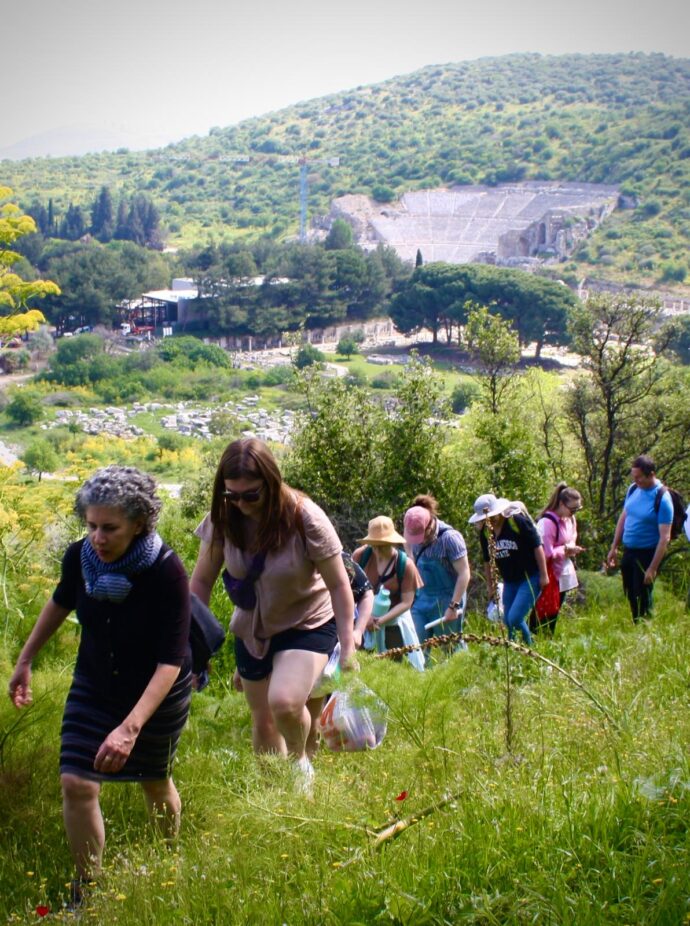
Photo: Laura Salah Nasrallah, students, and colleague Michael Penn of Stanford University hiking to the Grotto of Paul and Thekla in Ephesus, Turkey
In 2025, ACLS awarded 62 of these namesake fellowships. These projects represent an exciting mix of traditional and contemporary research reflecting the varied perspectives of our world, from a project tracing a literary history of migration in the early modern world to a book on the Mexican American influence on country music. While one project explores the creative ways that Native Americans used legal institutions to claim property and defend territory across North America from 1763–1891, restoring the voices of Indigenous actors in the historical narrative, another presents South Africa’s Anti-Apartheid struggle as a global Black-led movement rather than a phenomenon of white solidarity.
In addition to supporting immediate research needs of scholars, ACLS Fellowships have meaningfully impacted their lives and careers. For many, this has meant the time to finish a manuscript or travel to research sites, join convenings with other scholars with similar research agendas, and participate in scholarly activities that may have otherwise remained out of reach given today’s climate of departmental budget cuts and restrictions.
“Time is crucial in the early stages of a new research project, and energy studies is highly diverse and interdisciplinary. This spring, I’m visiting University of Illinois, Urbana-Champaign’s Humanities Research Institute. I just workshopped a draft chapter with their Environmental Humanities research cluster,” noted 2025 Fellow Eric S. Godoy, Associate Professor of Philosophy at Illinois State University. He is using his fellowship to advance a book project on energy democracy and ethics.
“I was also invited to give a public talk at Centre College, which was co-sponsored by University of Kentucky’s Tracer Farmer Institute for Sustainability and the Environment. It’s a multiday visit to both institutions. Coal is such an important part of Kentucky’s history and culture. I’m really looking forward to talking with scholars and students there who are working on energy transition in the heart of Appalachia. It’s such a wonderful opportunity that would have been difficult to make happen without the support of ACLS.”
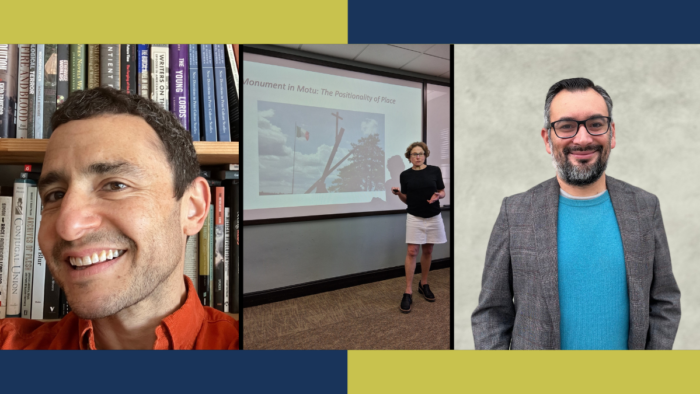
Jesse Schwartz, Louise Zamparutti, and José Miguel Palacios.
“As someone who labors beneath the burden of a community college teaching load, making room for writing is always challenging, and even more so for research,” said 2025 Fellow Jesse W. Schwartz, Professor of English at LaGuardia Community College (CUNY). His fellowship will allow him to complete his monograph, America’s Russia: The Bolshevik Revolution, Racial Socialism, and US Print Culture, 1882–1929, which traces American cultural responses to transnational socialism in the late nineteenth and early twentieth centuries. “Thanks to the full year of uninterrupted time afforded me by the fellowship, I will now be able to finish the entire manuscript much sooner than anticipated and, what’s more, the increased level of focus has substantially improved the quality of the project overall.”
In 2025, the program also awarded 36 ACLS Project Development Grants, the highest number in recent years, recognizing faculty in teaching-intensive roles as they work to advance their research.
“The grant offered much-needed funding to protect my time and devote it to writing drafts of two book chapters during the summer,” said 2025 Grantee José Miguel Palacios, Assistant Professor, Cinematic Arts at California State University, Long Beach. He was awarded the grant to support his book The Cinema to Come: The Archives, Writings, and Films of Raúl Ruiz. “More broadly, the ACLS support has meant a strong institutional backing for my second academic book when it is still in its early stages of development, which is an incentive in itself for me as a scholar working in a teaching institution with a heavy instructional workload.”
The ACLS support has meant a strong institutional backing for my second academic book when it is still in its early stages of development, which is an incentive in itself for me as a scholar working in a teaching institution with a heavy instructional workload.
José Miguel Palacios, 2025 ACLS Project Development Grantee
Assistant Professor, Cinematic Arts at California State University, Long Beach
“The grant has allowed me to fund my residency at the Institute for Research in the Humanities at UW–Madison, where I have a fellowship for spring semester 2026,” said 2025 Grantee Louise Zamparutti, Associate Professor at the University of Wisconsin–La Crosse. Her book, Monument in Motu: The Positionality of Place, examines some of the rhetorical processes by which extreme political viewpoints can become acceptable and popular. “It will allow me to finish my book during my fellowship period and to benefit from the support of my fellow cohort at the IRH.”
As part of our commitment to our mission to advance scholarship in the humanities and social sciences, ACLS is proud to continue offering our signature fellowship program, funded primarily by the ACLS endowment, with special awards sponsored by a generous group of benefactors who share our commitment to supporting excellence in humanistic knowledge production.
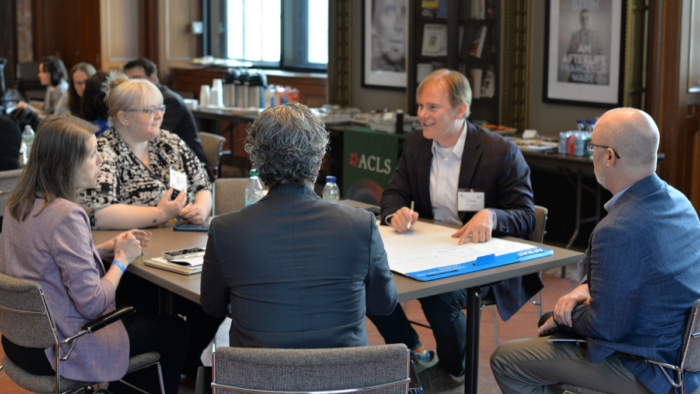
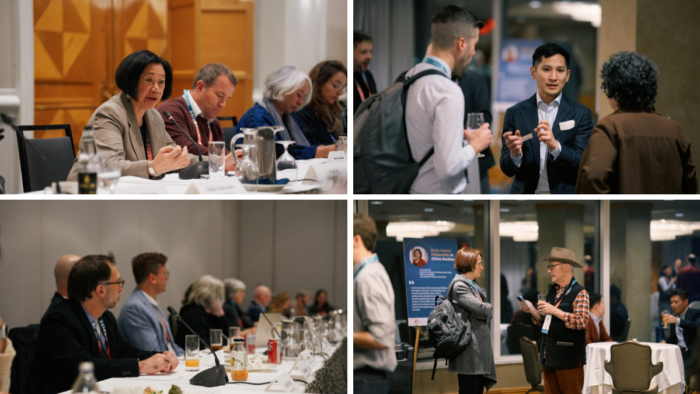
ACLS and The New York Public Library held an April 2026 convening to make the case for the value of collaborative research in the humanities and social sciences
Hear from first-generation scholars at multiple career stages about how mentorship, community, and support through fellowships have shaped their research and paths in higher education.