Recovering the Histories of Land Treaties in East and Southern Africa
2022 ACLS Digital Justice Seed Grantee Uses Digital Humanities to Illuminate Consequences of Land Treaties
Published: April 22, 2026
In a video interview, Ng’ang’a Wahu-Mũchiri, Associate Professor of English at the University of Nebraska-Lincoln, shares insights on the ACLS Digital Justice Seed Grant project, “Recovering the Histories of Land Treaties in East and Southern Africa.” The project aims to develop a large-scale digital humanities exhibition that illuminates the creation, history, and long-term consequences of land treaties in nineteenth-century eastern and southern Africa.
The ACLS Digital Justice Grant Program, supported by the Mellon Foundation, awards digital humanities projects at various stages of development that diversify the digital domain, advance justice and equity in digital scholarly practice, and/or contribute to public understanding of racial and social justice issues.
Watch the interview and read the transcript below:
Project Background
Ng’ang’a Wahu-Mũchiri: Places where you could initially cross through, move your livestock through, or grow food were all of a sudden out of bounds. And if you found yourself in those spaces, you were trespassing.
Ownership of the land changed from the people who had grown up there, the people who were invested in sustainably ranching or farming in those spaces. Ownership of the land moved to the colonial government. The idea was to recover some of these treaties, digitize them, and present them to communities online, curate them online and have some of the communities that are still affected by those policies interact and engage in public conversations with those documents.
Developing Global Partnerships
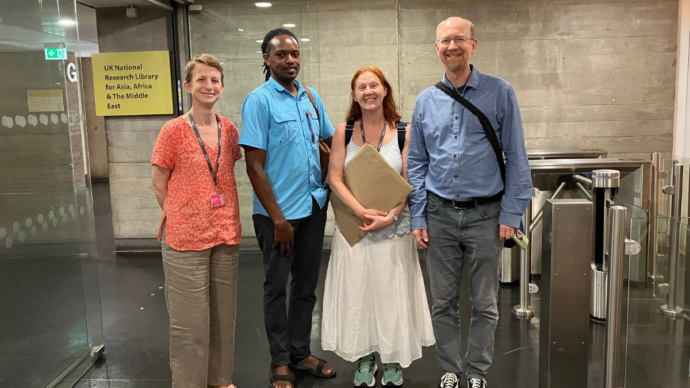
Wahu-Mũchiri: In the Kenyan case, we were working with Chao Tayiana Maina, who is an expert digital historian. We were working with Jo Davis and Jo Ichimura both of whom have created good knowledge around the national records and the British library.
Ownership of the land moved to the colonial government. The idea was to recover some of these treaties, digitize them, and present them to communities online, curate them online and have some of the communities that are still affected by those policies interact and engage in public conversations with those documents.
Ng’ang’a Wahu-Mũchiri
Impact of ACLS Digital Justice Grant
Wahu-Mũchiri: One of the things the grant enabled us to do was to bring on board a translator Mziwanda Obanda who could work with the completed critical documents and translate them into Swahili. Some of the colonial land treaties are still not accessible to the communities that are mostly affected by those policies and to us that’s a gap that is lacking.
The ACLS Seed Grant was a perfect mechanism for Adrian [Wisnicki] and myself at the stage that we were in our project. We had an idea, but we wanted to actually have a proof of concept and the Seed Grant is specifically geared towards this kind of experimental phase of the project. The risk involved and the potential for failure was fairly high and I don’t get the sense that a lot of external funders are willing to kind of invest at that very early stage of scholarly ideas.
ACLS Digital Justice Grantees combine machine learning with hands-on training for HBCU students to democratize access to overlooked historical records .
Stephen Davis, William Mattingly, and Stanley Sello G’22, G’24 share their research using machine learning to uncover the history of Black women in South Africa during apartheid.
ACLS hosted digital humanities scholars, librarians, and archivists for workshops alongside the annual conference of the Alliance of Digital Humanities Organizations.