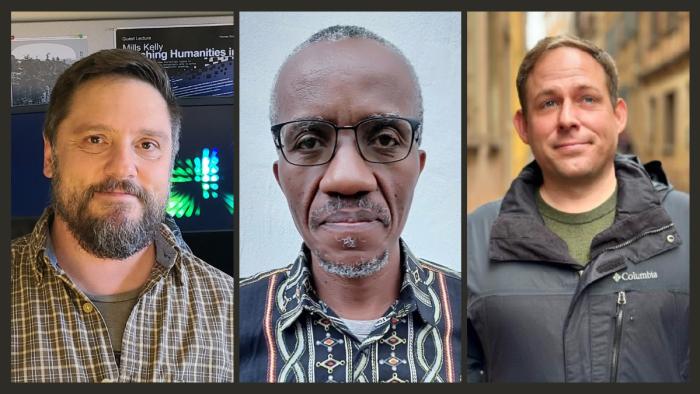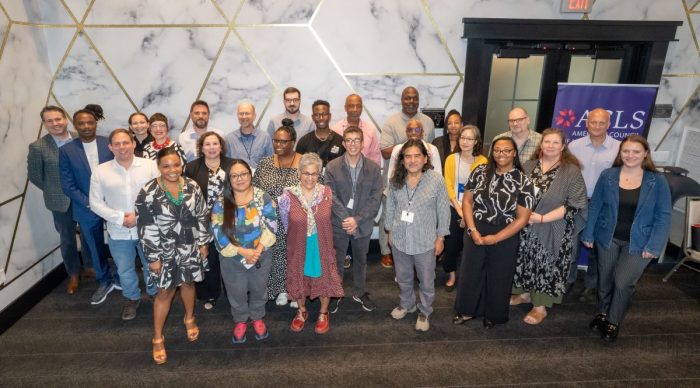
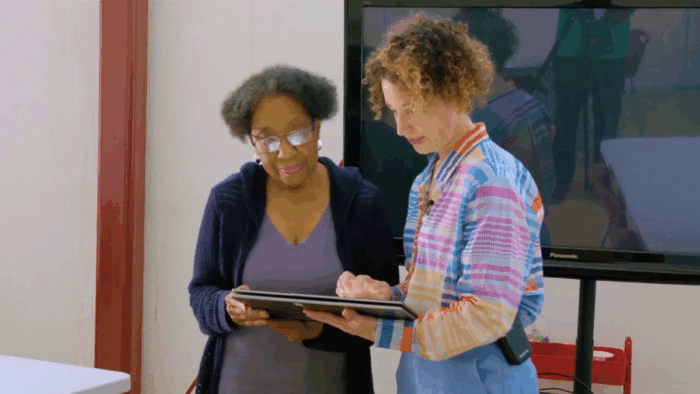
In a video interview, Jane Landers, Justin Jones, David Lafevor, and Daniel Genkins share their work on the 2022 ACLS Digital Justice Development Grant project Recruiting and Training the Next Generation of Slave Societies Digital Archive (SSDA) Scholars.
The Slave Societies Digital Archive holds the oldest and most extensive serial records for African and Indigenous people and their descendants in the Atlantic World. Previously supported by a 2016 Digital Extension Grant, the 2022 ACLS Digital Justice Development Grant allowed SSDA to develop machine learning to enhance access to centuries of under-utilized or understudied records for the history of Black, Latinx, and Indigenous communities stored in SSDA. Through the grant, SSDA also recruited and trained students from Fisk University, Tennessee State University, and Middle Tennessee State University to work on SSDA’s machine-learning initiative, transcribe historic documents, and develop digital projects related to their research interests.
The ACLS Digital Justice Grant Program, supported by the Mellon Foundation, awards digital humanities projects at various stages of development that diversify the digital domain, advance justice and equity in digital scholarly practice, and/or contribute to public understanding of racial and social justice issues.
Watch the interview and read the transcript below:
Jane Landers, Gertrude Conaway Vanderbilt Professor of History, Vanderbilt University, and Director, Slave Societies Digital Archive: Many people think that African history in the Americas is erased or lost or impossible to find, and our project proves it isn’t. The American Council of Learner Societies Digital Justice Grant has allowed us to work with American students from HBCUs, Historically Black Colleges and Universities. We received enough to have three fellows come to work with us in the Slave Societies Digital Archive.
Twenty years ago we started this project, and I’ve been working with teams in the Americas, Latin America, Africa, and the Caribbean to try to preserve the oldest history for Africans in the Atlantic world. And we have the largest serial records for Africans in the Americas now.
We’re getting people trained in digital preservation work, in very important and usually overlooked records, to try to make this work go forward. So I feel like every grant that we receive trains a new group of students who will then be committed to carry the work on after I retire.
Justin Jones, PhD Candidate in History at Vanderbilt University: I’ve been helping with some of the field collection now. When we were in Mompox, Colombia a few months ago, I was helping to actually scan and preserve some of the records that are now being processed and they’ll be available on the website. After we have these records processed, I’ll be working with the transcription and analysis of some of these records and then working with some of the geospatial mapping and geographic analysis.
Every grant that we receive trains a new group of students who will then be committed to carry the work on. Jane Landers
David Lafevor, Associate Professor of Latin American History and Digital Humanities, University of Texas at Arlington: Some pages for example in ecclesiastical documents are so deteriorated due to the iron content of the ink, due to insect and water damage, that turning the page itself takes two people doing it very carefully. We don’t want to damage the documents that are already deteriorated to a significant degree. For the moment what we are most concerned with is triaging the information that these books contain. So being able to produce digital copies that are legible even if they are not perfect, even if they are not ideal, is far preferable to losing these documents completely.
Daniel Genkins, Mellon Assistant Professor of History and Digital Humanities, Vanderbilt University: With the ability to use AI and other automated techniques to process documentary collections like the Slave Societies collection at scale, it immediately gives us access to us as historians to an order of magnitude more data than we had previously.
We use multimodal models—the same kind of like language models that you’re used to interacting with, like ChatGPT or Gemini for example. We literally just pass an image to these models and it returns to us line by line what the image says, or what it thinks the image says. Together they are more powerful than either one of them in isolation.
Justin Jones: The main thing that doesn’t necessarily come across when you’re just looking at the image on a computer, or you’re reading a book that’s been based on these images, is that it’s a very people-centered process. We’re working with priests, and with assistants to the priest, and the church is still active. So we’re working in a space that’s still being used for worship and these records are still being used for day-to-day life. People are coming up to the desk and requesting similar images, like we’re looking at baptism records from 1700 and people want the ones from 1995 when they got married or when their kid was born. It’s a living process. This history is not just something that’s in the past.