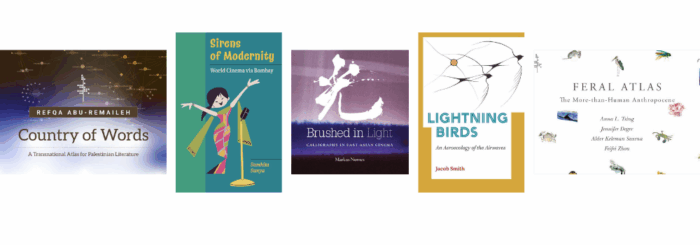
The 2025 finalists in the multimodal category of the ACLS Open Access Book Prizes and Arcadia Open Access Publishing Awards showcase the creative potential of open access platforms in reimagining the monograph. Supported by a generous grant from Arcadia, the prizes recognize and reward authors and publishers of exceptional, innovative, and open humanities books published from 2018 to 2023. Eligible open access books in the multimodal, born-digital category demonstrated effective and innovative use of the online environment in any humanistic discipline.
Below, the authors share insights about their research, publication experience, and why they chose open access and a multimodal format.
Professor of Asian Cinema, University of Michigan
What is your book about?
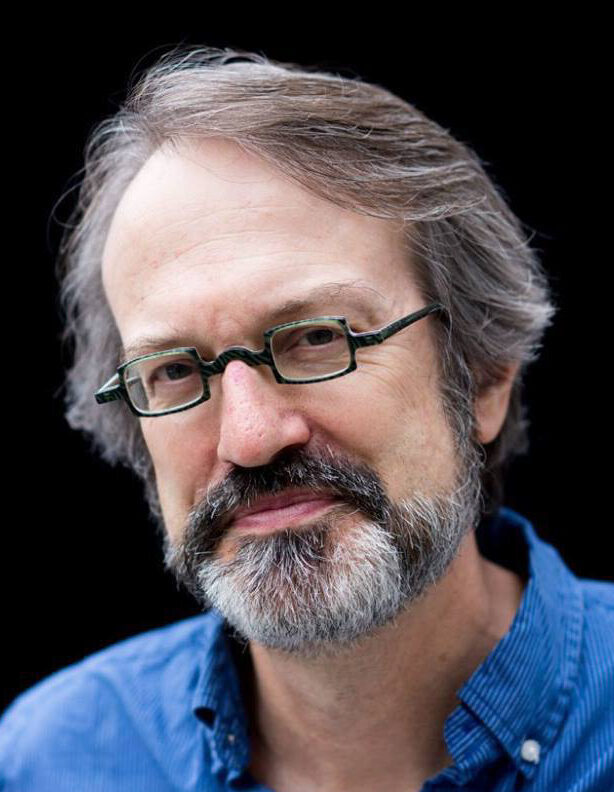
Brushed in Light examines how the brushed word appears in films and in film cultures of Korea, Japan, Taiwan, Hong Kong, and People’s Republic of China cinemas. This includes silent-era intertitles, subtitles, title frames, letters, graffiti, end titles, and props. It is aimed at scholars of cinema, Asian studies, art history, translation studies, and a general readership. None of these fields have considered the calligraphic word in cinema, despite its surprising ubiquity.
With the support of the University of Michigan Press, we created a stunning, square-shaped paper version alongside a complex digital version.
Abé Markus Nornes
How did using a multimodal, open access format benefit your publication?
The invitation to join University of Michigan’s TOME (Toward an Open Monograph Ecosystem) initiative and make my book open access was a wonderful opportunity, and I made the most of it. With the support of the University of Michigan Press, we created a stunning, square-shaped paper version alongside a complex digital version. This was the first time I conducted research using a corpus of images, which came to 3,000 frame grabs by the time of writing. The open access book links to not only the images used in the text but also the entire corpus. For example, when readers come to the section on the somatic aspects of the act of writing, they can click on a link and summon all 55 examples available in the Fulcrum corpus.
Professor of Modern Arabic Literature and Film, Freie Universität Berlin
Why did you decide to pursue open access publication?
Given the fragmentation, loss, and catastrophic ruptures suffered by Palestinian literary heritage, as well as the thankless labor involved in gathering decentralized fragments, the digital realm becomes the only sphere where knowledge can exist in one open and fully accessible location. In this regard, Stanford University Press (SUP) with its digital projects arm made it possible to create, host, and preserve knowledge in a unique multimodal and interactive online environment. SUP is the only publisher that shared my commitment to born-digital publishing for posterity, codifying best practices for preservation, authenticity, and stewardship of digital material.
What did you hope to accomplish by publishing a multimodal project?
The vision I had for Country of Words as a textual-audio-visual reading, research, and learning digital environment would not be possible in a conventional print book format. Country of Words provides multiple entry points and scalable perspectives on Palestinian literary history, prioritizing participatory, interactive, and nonlinear modes of engagement. It represents parallel histories through a contrapuntal approach that highlights continuities despite a history of ruptures. Readers and users can delve into layers of interpretative possibilities, toggling between close and distant readings, qualitative and quantitative perspectives, micro and macro, and the local and global to view large-scale patterns as well as dive into detailed analyses.

Given the fragmentation, loss, and catastrophic ruptures suffered by Palestinian literary heritage, as well as the thankless labor involved in gathering decentralized fragments, the digital realm becomes the only sphere where knowledge can exist in one open and fully accessible location.
Refqa Abu-Remaileh
Anna L. Tsing, Distinguished Professor of Anthropology, University of California, Santa Cruz
Jennifer Deger, Professor of Digital Humanities, Charles Darwin University
Alder Keleman Saxena, Assistant Professor of Anthropology, Northern Arizona University
Feifei Zhou, Independent Scholar
Joint statements from all authors
Why did you decide to pursue open access publication?
Open access not only enables the widest possible public to freely navigate the atlas but also supports our commitment to mobilizing an intellectual commons. As we state in Feral Atlas, this commons is a set of approaches to the Anthropocene in which heterogeneity and open-endedness are essential characteristics. It is neither bounded nor exclusive; differences—across continents and regions, across disciplines, across ontologies, and across forms of access and privilege—are key. And yet, taken together, the multiple voices, media, and disciplinary perspectives in Feral Atlas urge a collective shift in how we make sense of the world. How could such a shift be invoked behind a paywall?
Taken together, the multiple voices, media, and disciplinary perspectives in Feral Atlas urge a collective shift in how we make sense of the world. How could such a shift be invoked behind a paywall?
Authors of Feral Atlas: The More-Than-Human Anthropocene
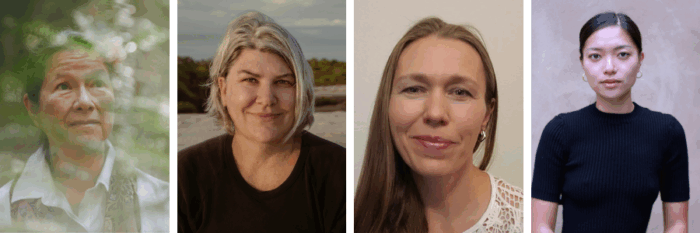
From left: Anna L. Tsing, Jennifer Deger, Alder Keleman Saxena, Feifei Zhou
What have been the benefits of publishing this work open access?
Open access has delivered Feral Atlas the readership we dreamed of from the start. It moved rapidly around the world and beyond English-speaking environments, unlike a traditional print book restricted by the institutions, languages, timelines, and costs of publishing. We are not only reaching multi-lingual publics in Europe, but also, more recently in the Global South. For example, the Pinacoteca de São Paulo, a major contemporary art museum in Brazil, included Feral Atlas in Once upon a Time: Visions of Heaven and Earth, an exhibition on environmental change. The open access, web-based format allows the project to be viewed in its original form, with the help of the imperfect-but-immediate services of Google Translate to display text in Portuguese.
Professor, Radio/Television/Film, Northwestern University
What is your book about?
Lightning Birds presents a new history of radio that understands the medium not as a channel of popular entertainment but as a tool for the study of bird migration. Interweaving the voices of scientists and conservationists with music, sound art, and audio storytelling, Lightning Birds initiates a dialogue between ornithology and media studies, and creates a new model for open source, multimodal scholarship in the environmental humanities.
Why did you decide to pursue open access publication?
Lightning Birds was best realized as an open access publication in audio because of the project’s potential to reach audiences including but extending beyond academics. There is an urgent need to make people understand and appreciate birds and their migratory lifeways given that 13 percent of all bird species are threatened with extinction. The more we know about birds and their use of the sky, the more we might acknowledge and minimize our destructive actions. An open access audio publication is an effective way to address not only scholars, but sound artists, environmental activists, ornithologists, and communities of birders and birdwatchers. It was exciting to explore a new channel of communication about an issue of vital ecological importance.
An open access audio publication is an effective way to address not only scholars, but sound artists, environmental activists, ornithologists, and communities of birders and birdwatchers. It was exciting to explore a new channel of communication about an issue of vital ecological importance.
Jacob Smith
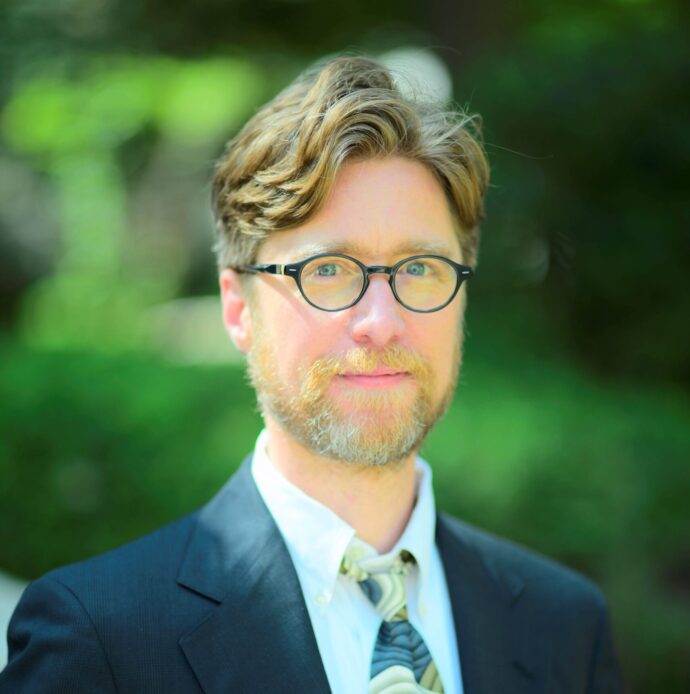
Photo Copyright @SeanSuPhoto | @PurplePhotoCo.
Associate Professor of Cinema, University of Virginia
What is your book about?
Sirens of Modernity is a feminist history of the prolific, transnational circuits of Hindi-language song-dance films, amid the efflorescence of European art cinema and Cold-War-era forays of Hollywood abroad over the long 1960s. It takes seriously a set of seemingly odd Hindi films’ own reflexive arguments about love, cinema, and cinephilia to show how and why they expressed a deep faith as well as ambivalence toward popular cinema’s ethical capacity to shape a more egalitarian world. Sirens addresses the necessity and challenge of cross-border historiography in the fields of global media history, South Asian studies, and gender and sexuality studies.
I pursued open access publication to close the gap between my US-based institutional and geographic location, on the one hand, and the institutional and geographic locations of my research areas, on the other.
Samhita Sunya
Why did you decide to pursue open access publication?
I pursued open access publication to close the gap between my US-based institutional and geographic location, on the one hand, and the institutional and geographic locations of my research areas, on the other. A pivotal point in my graduate training came from the “tough love” mentorship of an early-career film scholar visiting from India. He saw so many blind spots in my nascent thesis and urged me to engage more with South Asia–based scholars of South Asian cinema, and to consider how much one’s social, institutional, and geographic locations affect the questions, stakes, and limits of one’s work. This advice profoundly transformed—for the better—not merely my scholarship, but also my community of scholars and friends.
ACLS Open Access Book Prize + Arcadia Open Access Publishing Award
Supported by a generous three-year grant from Arcadia, these prizes recognize and reward the authors and publishers of exceptional, innovative, and open humanities scholarship. The winning title in each category receives dual awards.
Meet the Rest of the 2025 Open Access Book Prize Finalists
-
The 2025 history finalists share insights about their research, publication experience, and why they chose open access.
News Article
July 14, 2025
-
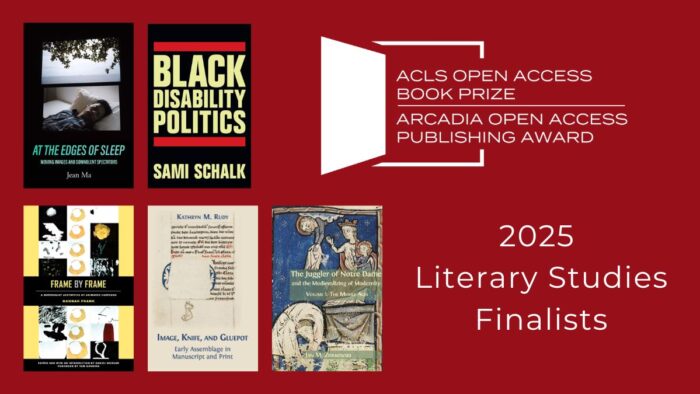
The 2025 literary studies finalists offer vital contributions to the humanities that are freely accessible to readers worldwide.
News Article
August 5, 2025
-
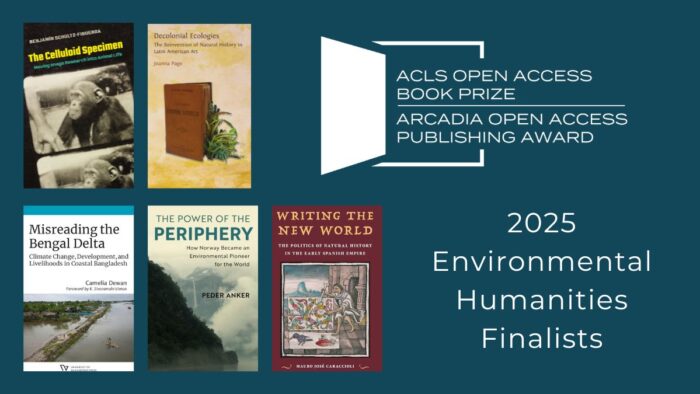
Authors share their works exploring the complex relationships between humanity and the environment.
News Article
August 4, 2025