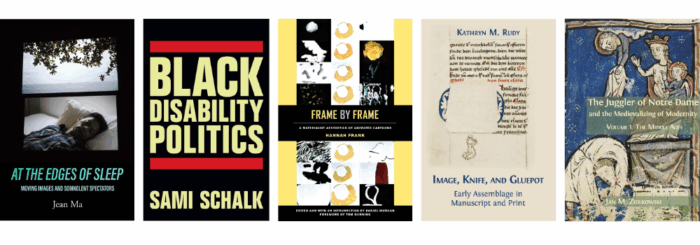
Meet the 2025 ACLS Open Access Book Prize Literary Studies Finalists
Published: August 5, 2025
The 2025 literary studies finalists for the ACLS Open Access Book Prizes and Arcadia Open Access Publishing Awards offer vital contributions to the humanities that are not only intellectually rigorous, but also freely accessible to readers worldwide. Supported by a generous grant from Arcadia, the prizes recognize and reward authors and publishers of exceptional, innovative, and open humanities books published from 2018 to 2023.
From groundbreaking scholarship on sleep in cinema and Black disability politics to richly illustrated explorations of medieval manuscripts and animation theory, these finalists share a commitment to expanding the boundaries of scholarship. In their reflections below, the authors describe how open access has deepened the impact of their work, fostered new audiences, and encouraged creative experimentation with form and voice.
Mr. and Mrs. Hung Hing-Ying Professor in the Arts, University of Hong Kong
Why did you decide to publish open access? It was very important to me to publish the book in open access, and one of the reasons I reached out to my editor at University of California Press was their pioneering Luminos program. At that time, it was the only top academic press in film studies that gave authors the option of signing on directly for open access publication. I wanted the book to be available for use as a teaching text without barriers for students unable to afford the cost of an academic book. This consideration was especially pressing because of the book’s focus on a Thai filmmaker and artist, making it a potential teaching text for use in universities in Thailand (where English literacy levels are high in tertiary education).
I wanted the book to be available for use as a teaching text without barriers for students unable to afford the cost of an academic book. This consideration was especially pressing because of the book’s focus on a Thai filmmaker and artist, making it a potential teaching text for use in universities in Thailand.
Jean Ma
What have been the benefits of publishing this work open access? Publishing in open access brought an unexpected benefit. In the midst of writing, I realized that the book’s content and approach were not suited to the standard format of the academic monograph. I decided that breaking down the book into a larger number of chapters shorter than the typical length would be more suitable to my endeavor of combining a deep dive into Apichatpong’s corpus with a multi-pronged investigation of the broader topic of sleep. My earlier decision to publish the book on a new, non-traditional platform gave me the courage to adopt a non-conventional structure.
Professor of Gender & Women’s Studies, University of Wisconsin-Madison
What is your book about? Black Disability Politics intervenes in the frequent overlooking and mis-recognition that occurs in both Black Studies and Disability Studies when it comes to how Black people, particularly Black activists, engage with disability as a political and social issue. By drawing attention to and outlining key qualities of Black disability politics in the work of the Black Panthers, the National Black Women’s Health Project, and contemporary Black disabled activists, this book aims to offer a new, innovative framework for identifying and interpreting articulations and enactments of Black disability politics, insisting that in order to dismantle white supremacy, we must also address and end ableism.
By drawing attention to and outlining key qualities of Black disability politics in the work of the Black Panthers, the National Black Women’s Health Project, and contemporary Black disabled activists, this book aims to offer a new, innovative framework for identifying and interpreting articulations and enactments of Black disability politics.
Sami Schalk
What have been the benefits of publishing this work open access? The benefits have been substantial. The work has circulated so much further than I think it would have without the open access version. I recently attended a conference in the UK and heard from people from at least a dozen countries who had read the open access book. I’ve also heard from student groups, book clubs, and non-profit organizations that they are reading the book as a collective and learning and discussing together. On a personal level, it has made promoting the book feel joyful because everywhere I go to give talks, I show a slide with a QR code for people to scan and immediately access the book. It feels like being able to give out knowledge candy wherever I go.
Daniel Morgan is Professor of Cinema and Media Studies, University of Chicago
Hannah Frank (1984–2017) was Assistant Professor of Film Studies, University of North Carolina, Wilmington
Why did you decide to pursue open access publication? The goal of publishing Frame by Frame in open access was to ensure that it was read as widely as possible, and to be read—in part and in whole—by academic and non-academic readers alike. Open access also served another, more personal goal. The author, Hannah Frank, died suddenly and unexpectedly of bacterial meningitis at the age of 33, one year into her job as Assistant Professor at the University of North Carolina Wilmington. The book is a lightly revised version of her dissertation, with a personal remembrance by Tom Gunning as a preface and a more scholarly introduction that I contributed. Open access allowed Frame by Frame to become a public tribute to the enduring power of Frank’s work, and a memorial for a life that was cut short.
Who are the primary audiences for this book? The primary audience has largely been academic, and Frame by Frame has been cited close to a hundred times in the past few years. It is no exaggeration to say that it has transformed the scholarship on animation studies, while also contributing deeply to media and industry studies and to the study of the postwar American avant-garde. But Frame by Frame is being read by more than academics. With over 10,000 downloads, its readers now include critics and animators, and the ease of open access is allowing the book to spread among these audiences as well.
Frame by Frame has been cited close to a hundred times in the past few years. It is no exaggeration to say that it has transformed the scholarship on animation studies.
Daniel Morgan
Bishop Wardlaw Professor, School of Art History, University of St Andrews
Can open access publications play a role in tenure and promotion? Open Book Publishers creates high-quality books by relying on qualified external reviewers, whose gentle criticism has always improved the final version. Actively lobbying for the benefits of open access publishing has helped legitimate it for my younger colleagues. With the metrics that OBP collects, I can show my supervisors that this book has had well over 10,000 views and downloads. At my university now, I have been promoted several times, and more quickly, because of this and my other open access books, because I haven’t had to wait the extra year for a hardcopy to appear; my university only promotes people on the basis of finished projects. A contract in hand does not count.
Open Book Publishers creates high-quality books by relying on qualified external reviewers, whose gentle criticism has always improved the final version. Actively lobbying for the benefits of open access publishing has helped legitimate it for my younger colleagues.
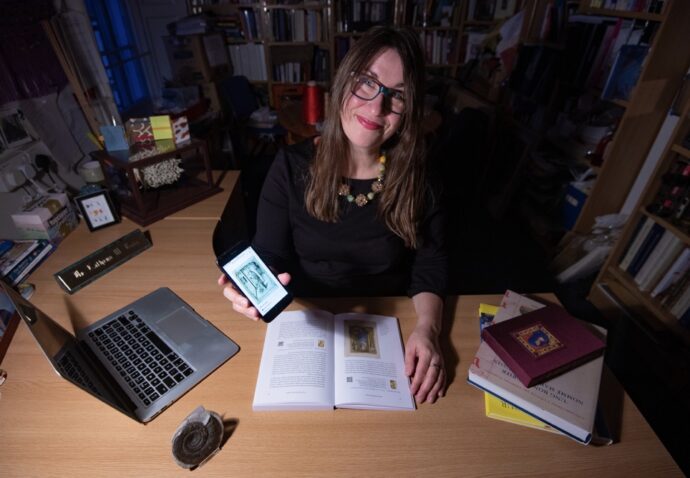
Kathryn M. Rudy
Who are the primary audiences for this book? The primary audiences for Image, Knife, and Gluepot are scholars and students in the fields of medieval studies, early book history, and manuscript studies, particularly those interested in the transition from manuscript to print and in material culture. The book’s personal writing style, which chronicles the research trips, blind alleys, and lacunae in the historical record, also appeals to students learning research methods in these fields. As an experimental book format (with images linked through QR codes), it is also valuable to those studying the history of academic writing and publishing.
Arthur Kingsley Porter Professor of Medieval Latin, Harvard University
What is your book about? The anthology that caps the project pursues two main objectives. The first half sets an Old French poem in the context of the Bible, medieval miracle tales, European traditional tales, and Jewish and Islamic traditions. The second comprises examples of modern poetry and prose that re-create the thirteenth-century original. The individual texts, translated from Latin, French, Spanish, German, Persian, and Hungarian, have brief introductions and notes. The entire project, the six-volume study and the one-volume anthology, is accessible in conventional printed editions and dynamically in a format allowing free movement between highlighted names and phrases in the text and commentary. This final piece of the project contains more than fifty illustrations, from nearly twelve hundred that preceded them.
Sometimes I have dreamed that books of mine could help, among others, college students, high school teachers, independent scholars, and the global community, but instead they have been walled off. This project had to be different.
Jan M. Ziolkowski
Why did you decide to pursue open access publication? Since setting aside administration, I have loved teaching and lecturing as well as producing scholarship. Simultaneously, I have felt limited by the gulf between what I could accomplish in oral delivery, with handouts, slides, and PowerPoints, and what for technical and legal reasons I could translate from those performances onto the page. Sometimes I have dreamed that books of mine could help, among others, college students, high school teachers, independent scholars, and the global community, but instead they have been walled off. This project had to be different.
ACLS Open Access Book Prize + Arcadia Open Access Publishing Award
Supported by a generous three-year grant from Arcadia, these prizes recognize and reward the authors and publishers of exceptional, innovative, and open humanities scholarship. The winning title in each category receives dual awards.