

ACLS Community Message for March 2026
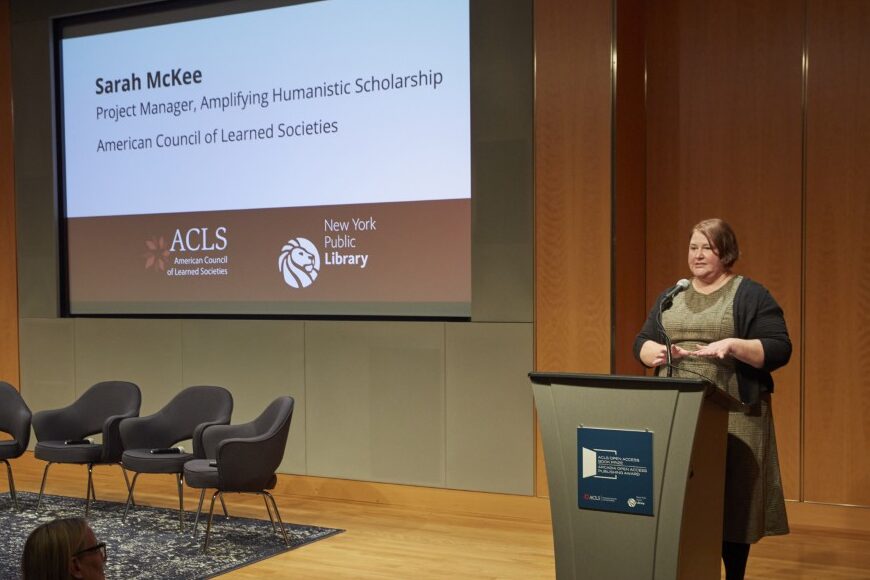
Three years ago, I joined ACLS to help promote the vitality of humanistic scholarship in a rapidly changing publishing environment. Much of this work focuses on support for open access and involves regular engagement with academic publishing and library communities. According to a 2020 study, fewer than 25 percent of papers on humanities scholarship were available open access, compared to nearly 70 percent available in the sciences. Now more than ever, as research and teaching in humanistic fields are increasingly scrutinized and, in some cases, being actively eliminated on US campuses, there is urgency around increasing access to scholarly titles to ensure a broad variety of students and scholars are able to benefit from them.
Last week submissions closed for the 2026 ACLS Open Access Book Prizes, supported by Arcadia. In the months ahead, our review panels and judges will select the winning books in each of six categories: Anthropology, Environmental Humanities, History, Literary/Media Studies, Multimodal, and Political Science. The announcement of the prize recipients will come this fall, but in the meantime we have three new open access titles—all supported by the 2024 and 2025 winning publishers—to celebrate!
The competition is structured so that the winning book in each category receives two awards—one for the author, and one for the publisher. Authors receive the ACLS Open Access Book Prize in the amount of $20,000. Publishers receive the Arcadia Open Access Publishing Award, which provides a $30,000 grant for opening at least two new forthcoming books.
This publishing award gives more authors the opportunity to publish their books as immediate open access. In the immediate model, open editions are available at the same time as print editions offered for sale, with no embargo period. Immediate open access is often an option only for those authors with access to substantial funding—usually in the form of a subvention from a well-resourced institution—to cover publishers’ open access fees (or book-processing charges). The Arcadia Open Access Publishing Award provides direct support to the winning publishers and relieves the funding burden for authors.
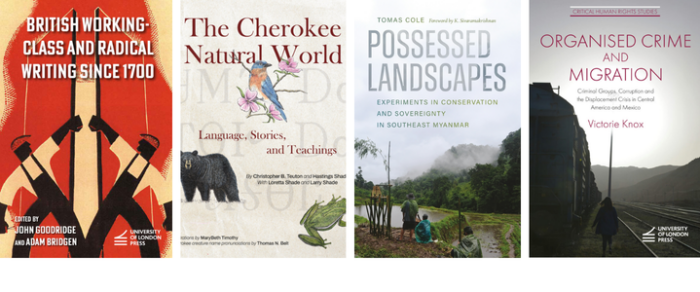
To date three winning presses have published new open access books supported by the grant. From the University of London Press, the 2024 winner in History, comes British Working-Class and Radical Writing since 1700, edited by John Goodridge and Adam Bridgen, and published in September 2025. That same month a new born-digital work, The Cherokee Natural World: Language, Stories, and Teachings, by Christopher B. Teuton and Hastings Shade, debuted from the University of British Columbia Press/RavenSpace, winner of the 2024 prize in Multimodal.
A few weeks ago the University of Washington Press, winner of the 2025 prize in Environmental Humanities, released Possessed Landscapes: Experiments in Conservation and Sovereignty in Southeast Myanmar by Tomas Cole. The open access edition is available on the Manifold platform.
And there’s more to come! The University of London Press recently announced a second book supported by the prize—Organised Crime and Migration: Criminal Groups, Corruption and the Displacement Crisis in Central America and Mexico by Victorie Knox, in the Critical Human Rights Studies series—forthcoming in June 2026.
I am especially excited about this aspect of the prize because it extends support for open access publishing to authors who would not otherwise receive it. Every year during the submission period I hear from multiple authors eager to find open access funding for their forthcoming books. Unfortunately, funding for individual titles in the current climate is increasingly difficult to find. But experimentation with new funding models offers the possibility for more authors to participate in open access publishing.
Alongside the Open Access Book Prizes, ACLS participates in another model for open access books that eliminates author funding requirements. The Path to Open pilot, hosted by JSTOR, allows publishers three years to recover expenses through print sales before opening the books to the world, with funding provided by library participants. ACLS administers the Path to Open Community Advisory Committee, a volunteer panel of publishers, libraries, and scholars that offers guidance and support to JSTOR during the pilot. In early January the collection’s first 100 books reached the three-year publication mark and flipped to open access.
Finding new ways for more authors to participate in open access—without first securing thousands of dollars in fees—not only extends the reach and potential impact for scholarly books. It also moves open access publishing itself in a more equitable and attainable direction for all humanistic scholars.
The impact of the flip was immediate and dramatic. JSTOR reports that usage of the first 100 books jumped more than 500 percent in the five weeks after they opened. Committee member Catherine Cocks, director of Syracuse University Press, recently shared an insightful blog post about the promise of Path to Open in furthering the university press mission to make scholarship widely available.
Among those first 100 books, all published in 2023, are five titles whose research was supported by ACLS:
- Marlene L. Daut (2019 ACLS Fellow), Awakening the Ashes: An Intellectual History of the Haitian Revolution (University of North Carolina Press)
- Philip Ewell (2020 ACLS Fellow), On Music Theory and Making Music More Welcoming for Everyone (University of Michigan Press)
- Carolyn L. Karcher (1986 ACLS Fellow), ed., An Appeal in Favor of That Class of Americans Called Africans by Lydia Maria Child, revised and updated edition (University of Massachusetts Press)
- Kathleen S. Murphy (2013 ACLS Fellow), Captivity’s Collections: Science, Natural History, and the British Transatlantic Slave Trade (University of North Carolina Press)
- Elizabeth O’Brien (2018 Mellon/ACLS Dissertation Completion Fellow), Surgery and Salvation: The Roots of Reproductive Injustice in Mexico, 1770–1940 (University of North Carolina Press)
By 2029, when the Path to Open pilot draws to a close, a total of 1,000 academic humanities books will be available as open access.
Finding new ways for more authors to participate in open access—without first securing thousands of dollars in fees—not only extends the reach and potential impact for scholarly books. It also moves open access publishing itself in a more equitable and attainable direction for all humanistic scholars.
Sarah McKee
ACLS Project Manager for Amplifying Humanistic Scholarship