How First-Generation Scholars Thrive Through Community
Published: November 12, 2025
According to Insights into First-Generation Doctoral Students, a Council of Graduate Schools research brief by 2024 AVDF/ACLS Fellow for Research on the Liberal ArtsRadomir Ray Mitic, 27% of doctoral students identify as first-generation in the United States. However, data distinguishing the percentage of first-generation students who continue into faculty positions is largely unavailable. The lack of data may reflect a systemic invisibility among first-generation scholars.
“As someone who began community college as a high school ‘drop out’ from the Appalachian South, raised by three resilient women with a high school education or less, there are many days where I feel out of place in a university setting…it is a story only possible because a small group of academics, most of whom came from modest means themselves, welcomed me into their community,” saysKasey Henricks, Assistant Professor in the Department of Criminology, Law, and Justice at the University of Illinois at Chicago and awarded an ACLS Digital Justice Development Grant in 2025.
“…it is a story only possible because a small group of academics, most of whom came from modest means themselves, welcomed me into their community.”
Kasey Henricks
For many first-generation students, even recognizing their own identity requires access to programs that name it, validate it, and offer support. “It wasn’t until I made it to college and joined Student Support Services, a [federally funded] TRIO program, at the University of Arizona, that I began to understand what it meant to be first-generation,” reflects Rebecca Covarrubias, Professor of Psychology at the University of California, Santa Cruz.
“The ideals [and vocabulary] of diversity, equity, and inclusion [DEI] initiatives and their attendant, but scarce, funding sources are facing mass scrutiny and defunding; yet they are nonetheless crucial pathways for racially marginalized and socioeconomically disadvantaged students,” said Kale Serrato Doyen, doctoral student in History of Art and Architecture at the University of Pittsburgh Kenneth P. Dietrich School of Arts and Sciences and 2024 Mellon/ACLS Dissertation Innovation Fellow.
The White House has defunded or terminated funding sources like National Endowment for the Humanities (NEH) and the Fulbright-Hays Program, weakening the pipeline that supports marginalized scholars like first-generation students and disrupting systems that enable success and sustainable outcomes for first-generation scholars. For PhD students like Doyen, that may mean that professional development is only made possible because of programs like the Dissertation Innovation Fellowship. “Without that broader reach, we won’t be able to fully tackle issues of access and inclusion. Universities, especially research-intensive institutions, are still inaccessible to many,” says Covarrubias.
For first-generation scholars, community is a key strength that fosters a sense of belonging and sustains their persistence. From mentorship to project funding, each step serves as a foundation towards long-term sustainability.
“As I developed a literacy of my field and long-term advising relationships, my mentors were able to learn from me about the needs and perspectives of first-generation students of color, ”Doyen reflects.
“This network has empowered me to value my lived experiences because they position me to uniquely address issues of race and class in my scholarship.”
Kale Serrato Doyen
We asked first-generation scholars to reflect on their unique experiences navigating higher education. Find more information on their research and perspectives below. ________________________________________________________________________________________________________________
“My research in the history of art and architecture explores how Black and Latinx artists in the United States observe the effects of structural racism in the built environment—an interest extending from my own experience growing up in my Midwest hometown, where Mexican-Americans have historically been spatially marginalized and isolated in the city. Support from the Mellon/ACLS Dissertation Innovation Fellowship has positioned my research as an urgent intervention in my field.”
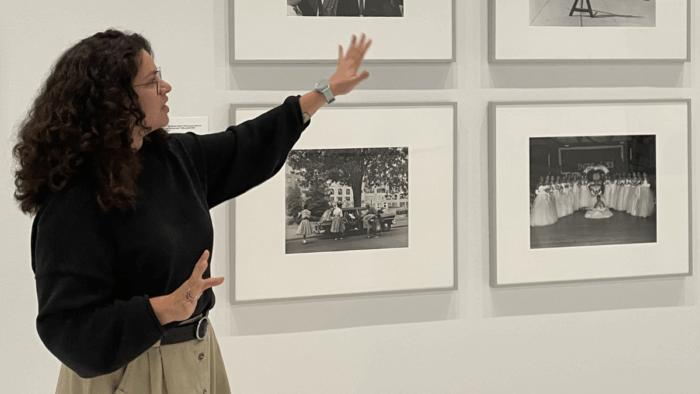
Kale Serrato Doyen leads a tour of the exhibition Black Photojournalism at the Carnegie Museum of Art in Pittsburgh, Pennsylvania.
Rebecca Covarrubias Professor of Psychology University of California, Santa Cruz Researcher on first-generation student belonging and equity in higher education Collaborative Research for Equity in Action (CREA)
“Much of what we investigate and explore in our research group stems from our own experiences within our own families and communities, and how we work to maintain these important connections in our lives. When I am writing or teaching or mentoring, I often find that I’m having conversations in my head with family members or former and current mentors. They illuminate so many considerations that help root our research work in issues that are relevant to our everyday lives. We hope that our research is accessible to anyone who wants to learn about it, can see themselves reflected in it, or wants to be in dialogue around it. In its simplest form, the reach is a genuine attempt to always stay in conversation with the wisdoms and experiences of the broader community.”
What advice would you give to future first-generation scholars navigating higher education?
Institutions thrive because of first-generation scholars and leaders like you. My advice is to try to remember how this is one part of many parts that make up who you are. And when it is hard to remember, lean on your various communities so that they may remind you.
Rebecca Covarrubias
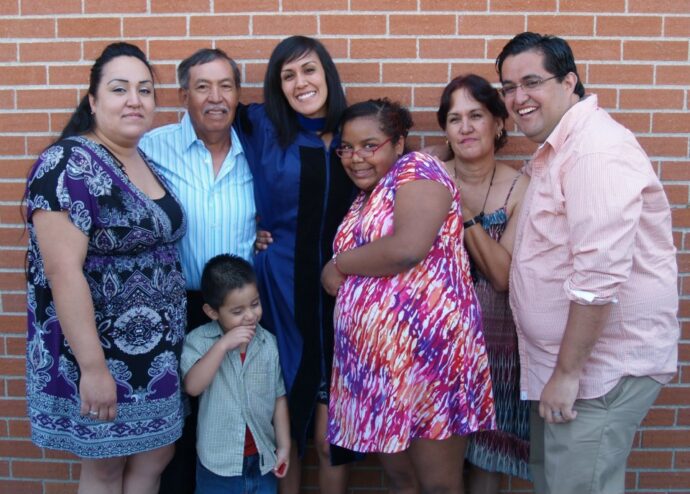
Covarrubias [center] with the family members who supported her throughout her PhD journey, University of Arizona, May 2012.
“My research agenda engages with innovative methodologies to foreground familiar objects, from lottery tickets to parking citations, within broader changes under capitalism. I am currently working on an ACLS-funded project that documents the pervasive problem of ticketing under false pretenses in Chicago. That is, it’s a project that identifies erroneous parking tickets issued under circumstances where restrictions do not apply. These tickets come with impositions of debt that impact virtually every community in the city, but they devastate many within Black and Latinx communities because they stack another problem on top of a broader crisis of precarity. It’s important for my research to reach broad audiences because the taken-for-granted objects I study profoundly shape most everyone’s daily life at a fundamental level.”
How has your community shaped your path as a first-generation scholar?
“My professional networks consist of trusted friends who push me to bridge my own biography with academic inquiry, providing me with models for engaged research that connects personal histories with collective struggles for a more just world.”
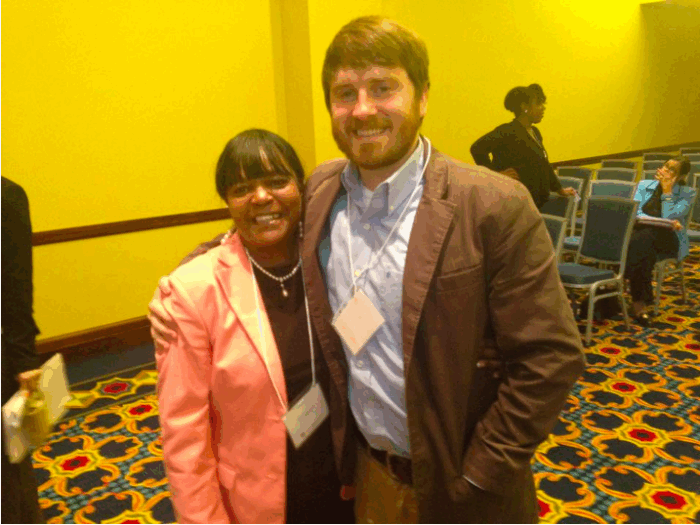
Kasey Henricks [right] and his Undergraduate Mentor Shirley Rainey-Brown [left] (Associate Vice Provost at Fisk University) at the annual meetings of the Mid-South Sociological Association.
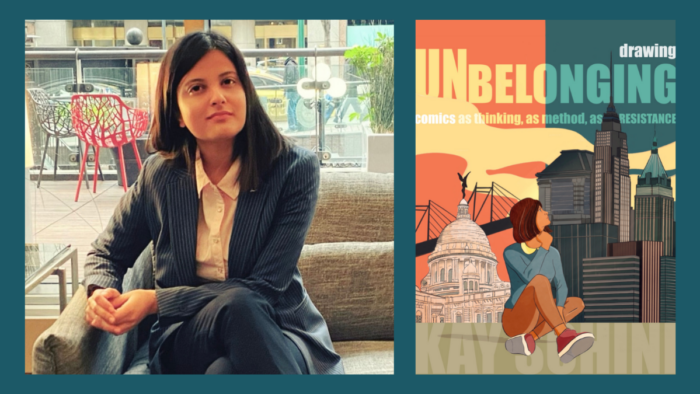
Kay Sohini F’21 discusses the process of creating her graphic dissertation using comics as a method, and how nontraditional approaches to scholarship can create space for inclusive work accessible to the public.