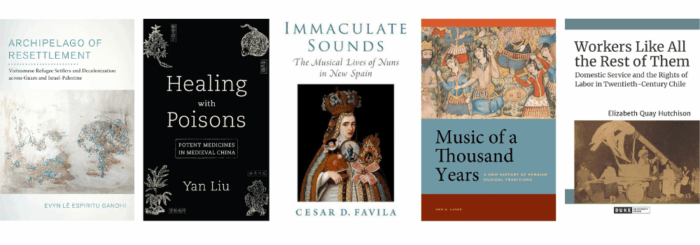
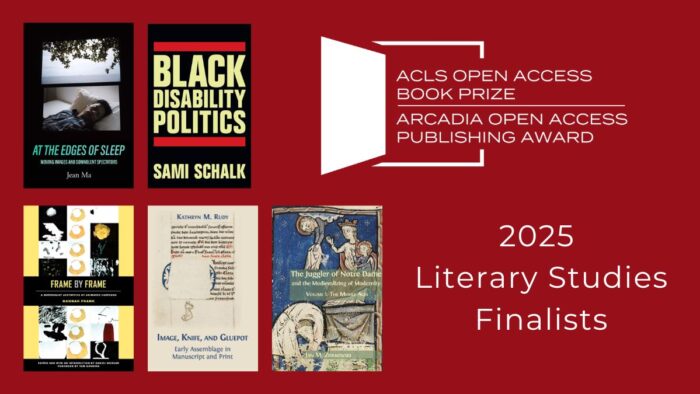
The 2025 finalists in the history category of the ACLS Open Access Book Prizes and Arcadia Open Access Publishing Awards span continents and centuries, with topics covering trans-Indigenous resistance, Persian musical traditions, labor movements in Latin America, and more. Supported by a generous grant from Arcadia, the prizes recognize and reward authors and publishers of exceptional, innovative, and open humanities books published from 2018 to 2023.
Below, the authors share insights about their research, publication experience, and why they chose open access—often to ensure their work remains accessible to the communities at the heart of their research.
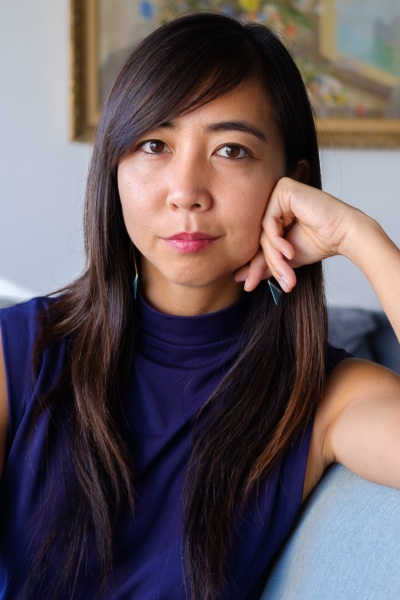
Associate Professor of Asian American Studies, University of California, Los Angeles
What is your book about?
My book examines Vietnamese refugee resettlement to Guam and Israel-Palestine, two spaces of settler colonialism, to theorize the “refugee settler condition.” It posits two forms of critical geography: first, archipelagos of empire, examining how the Vietnam War is linked to the US military buildup in Guam and unwavering support of Israel, and second, corresponding archipelagos of trans-Indigenous resistance, tracing how Chamorro decolonization efforts and Palestinian liberation struggles are connected through the Vietnamese refugee figure. Considering distinct yet overlapping modalities of refugee and Indigenous displacement, Archipelago of Resettlement offers tools for imagining emergent forms of decolonial solidarity.
Considering distinct yet overlapping modalities of refugee and Indigenous displacement, Archipelago of Resettlement offers tools for imagining emergent forms of decolonial solidarity.
Evyn Lê Espiritu Gandhi
What have been the benefits of publishing this work open access?
Publishing Archipelago of Resettlement open access has greatly increased the book’s readership and impact. Since publication, it has been downloaded from the UC Press Luminos website over 4,000 times. In summer 2022, I partnered with Guam Philharmonic Foundation to host a public history exhibit in Guam based on the book’s research. We distributed postcards with QR codes to the book’s Luminos open access webpage to all the exhibit attendees and worked with Guam’s educators to get Archipelago of Resettlement into classrooms as a key historical resource. Open access publication has also made the book readily available to students in the Global South, including those in Palestine and India.
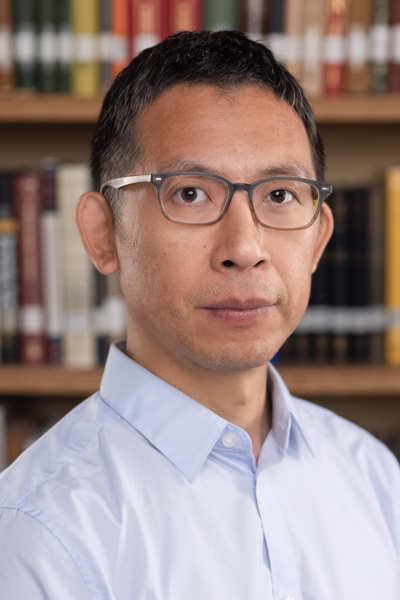
Associate Professor of History, State University of New York (SUNY), Buffalo
What is your book about?
As the first monograph in English on a historical study of poisons in China, my book makes a major contribution to the history of medicine in China and health humanities more broadly. By uncovering a forgotten yet important history of poisons deployed as healing agents in China’s formative era of pharmacy (200–800 CE), it debunks the long-held myth that contrasts the benign naturalness of Chinese herbal remedies with the dangerous side effects of Western synthetic drugs. Using poisons as a lens through which to examine the rich pharmaceutical ideas and practices in China’s past, the book highlights the importance of the technological, sociopolitical, and individual context that shapes the value of any given substance.
Why did you decide to pursue open access publication?
Throughout my academic career, I have been trying to make my works accessible to broad audiences. First, OA publication offers pedagogical advantages. Educators can assign the book, or parts of it, in their teaching without imposing a cost on students. Moreover, with a strong background in both science and humanities, I am eager to make my scholarship resonate with both humanists and scientists. OA publication facilitates my goal of fostering cross-disciplinary conversations. Finally, I would like my book to reach global audiences, especially those in Asia and those who are interested in alternative medical cultures and their histories. OA publication makes the book easily available around the world.
I would like my book to reach global audiences, especially those in Asia and those who are interested in alternative medical cultures and their histories. OA publication makes the book easily available around the world.
Yan Liu
Associate Professor of Musicology, University of California, Los Angeles
Why did you decide to pursue open access publication?
I never wanted the book’s price to dissuade curious people from reading the book completely. I grew up poor, and in college and graduate school I used library books or bought used books. I know what it is like to have to choose bills and groceries over books. And so open access was a very personal choice, and a correct choice, especially if I wanted to assign my book in my courses at UCLA. Los Angeles is extremely expensive, and our students’ financial struggles are a constant threat to their pyschological and intellectual well-being.

I had a successful tenure case because of my book. I was tenured early and promoted to a more advanced level of associate professor, thus having been awarded a promotion that ordinarily would have taken four years…the book’s accessibility was highlighted as being in line with the University’s mission to serve and educate the public.
Cesar D. Favila
Did the book have any impact on your tenure process?
I had a successful tenure case because of my book. I was tenured early and promoted to a more advanced level of associate professor, thus having been awarded a promotion that ordinarily would have taken four years. From the outside letters of support written by senior scholars in the field, to my chair’s letter on behalf of the department, to the council on academic personnel’s deliberation report, the book’s accessibility was highlighted as being in line with the University’s mission to serve and educate the public. Providing free access to faculty research and publications to communities outside of campus is important for public outreach and for fostering community-engaged research.
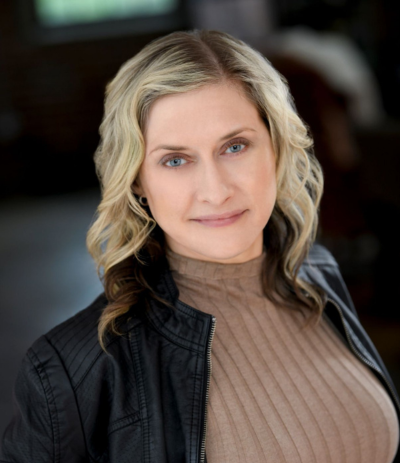
Associate Professor of Ethnomusicology, Boston College
Why did you decide to pursue open access publication?
My primary goal in publishing is to have my work reach as many people as possible, and open access publishing was essential for reaching the maximum number of interested readers. I also preferred the shorter/streamlined production timeline and the ability to include color photography. The latter really helped bring the book to life.
What have been the benefits of publishing this work open access?
It has reached so many people. I am still getting regular emails from Iranian scholars both inside and outside Iran who read the book and email me to tell me how it helped and changed their work. I don’t think I could ask for anything better than to have contributed to the next generation of Iranian music scholars. And there is no way so many would be deeply familiar with the book without open access to it online.
I am still getting regular emails from Iranian scholars both inside and outside Iran who read the book and email me to tell me how it helped and changed their work. I don’t think I could ask for anything better than to have contributed to the next generation of Iranian music scholars. And there is no way so many would be deeply familiar with the book without open access to it online.
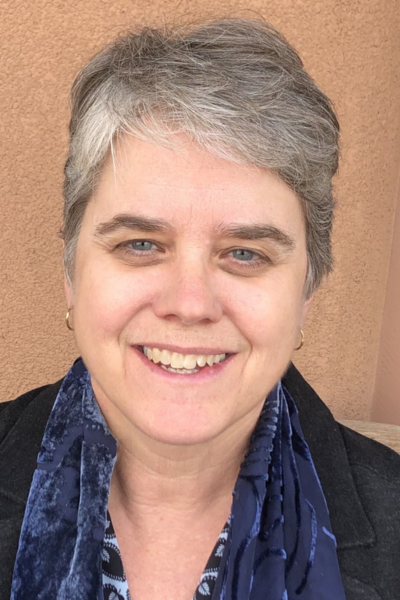
Ann E. Lucas
Professor of Latin American History, University of New Mexico
Who are your audiences for this book?
Research for this book began with my commitment to reaching broader audiences of Chilean activists and policymakers, students in a variety of fields, and my colleagues working in both Latin America and the United States. Structured around the arc of labor relations in twentieth-century Chile, my focus on domestic worker activism – both male and female, Catholic and secular – narrates stories of working-class politics, state-building, and women’s rights. In face-to-face interactions with Chilean audiences, I have been most gratified to learn about the book’s significance for contemporary domestic worker activists (who cite my findings in their publications), as well as students encouraged by how this history reflects what their own family members have experienced as domestic workers.
Research for this book began with my commitment to reaching broader audiences of Chilean activists and policymakers, students in a variety of fields, and my colleagues working in both Latin America and the United States.
Elizabeth Quay Hutchison
Why did you decide to pursue open access publication?
Broad dissemination of my research supports my commitment to historical research and teaching that can engage Latin American and global audiences. As Associate Vice President for Equity and Inclusion, I also participated in the University of New Mexico’s Open Educational Resources Working Group, which administers a federal Open Textbook Grant of $2.125 million. Duke’s exceptional open access publishing platform supports enhanced hemispheric collaboration in the field of Latin American gender history.
ACLS Open Access Book Prize + Arcadia Open Access Publishing Award
Supported by a generous three-year grant from Arcadia, these prizes recognize and reward the authors and publishers of exceptional, innovative, and open humanities scholarship. The winning title in each category receives dual awards.
Meet the Rest of the 2025 Open Access Book Prize Finalists
-
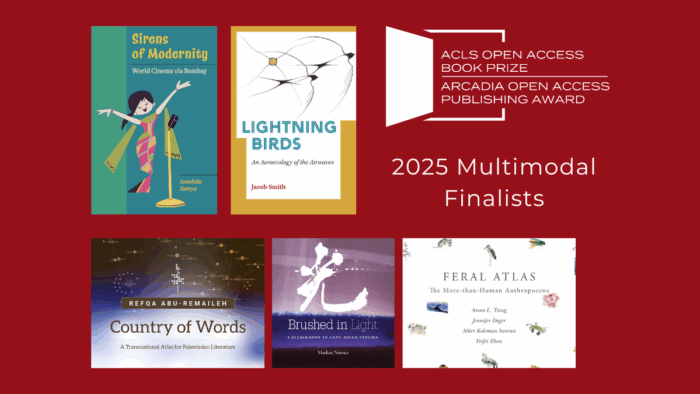
The 2025 multimodal finalists discuss their research and why they chose open access and a multimodal format.
News Article
July 15, 2025
-
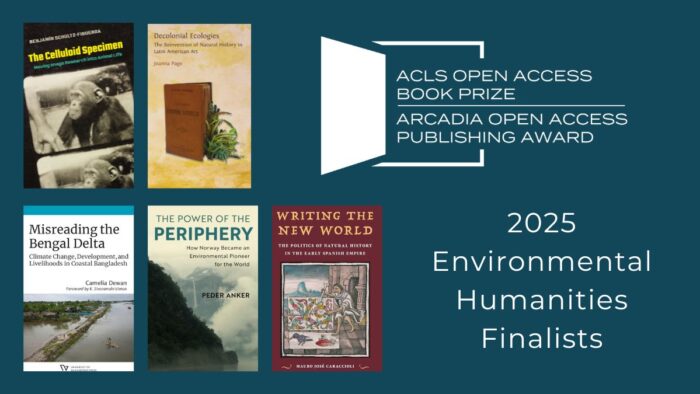
Authors share their works exploring the complex relationships between humanity and the environment.
News Article
August 4, 2025
-
The 2025 literary studies finalists offer vital contributions to the humanities that are freely accessible to readers worldwide.
News Article
August 5, 2025