
When I first joined the Intention Foundry (IF) as a facilitator in 2022, the social and political landscape of the United States—still grappling with a global pandemic and renewed proclamations for racial and social equity—seemed ripe with possibility. One of the ways ACLS met that moment was the Intention Foundry, a forum funded by the Mellon Foundation to advance equity, justice, and anti-racism for emerging scholars, leaders of ACLS member academic associations, and university administrators. Grounded in an ethics of care, the program cultivated spaces where honest and thoughtful collaboration across power and resource differentials yielded possibilities for a more diverse and thriving higher education ecosystem. These intensive three-day workshops provided early-career scholars and society executive directors time and space for candid discussions about generational changes within fields and the needs of early-career scholars.
The success of the Intention Foundry was made possible through recognizing interdependence as a tonic to the competition, individualism, and scarcity that often alienate scholars, departments, universities, and learned societies from each other. By extension, it also universalized the stakes of advocating for solutions to the growing intellectual, social, and financial precarity higher education is experiencing—a charge now more urgent than ever as individual scholars and even larger institutions face new existential threats to academic freedom and personal safety.
The success of the Intention Foundry was made possible through recognizing interdependence as a tonic to the competition, individualism, and scarcity that often alienate scholars, departments, universities, and learned societies from each other.
The Intention Foundry’s foundational practices and values continue to inform the program’s new directions, which began in fall 2024 with the Beyond Precarity: Incubators for Secure Futures series and the Learned Society Extended Engagement Microgrants. While the incubators offer thematically focused virtual and in-person space to break down institutional and disciplinary silos, learn new transformative skills, and imagine future directions for higher education, the microgrants fund equity-centered initiatives within and across learned societies that have ranged from data research studies of contingent faculty, to workshops on publishing, to institutes for professional development. Both new threads of the program center equity, justice, and wellbeing for scholars that disproportionately experience precarity in their fields. But they also demonstrate the specific impact of collaboration and interdependency when actualizing these efforts.
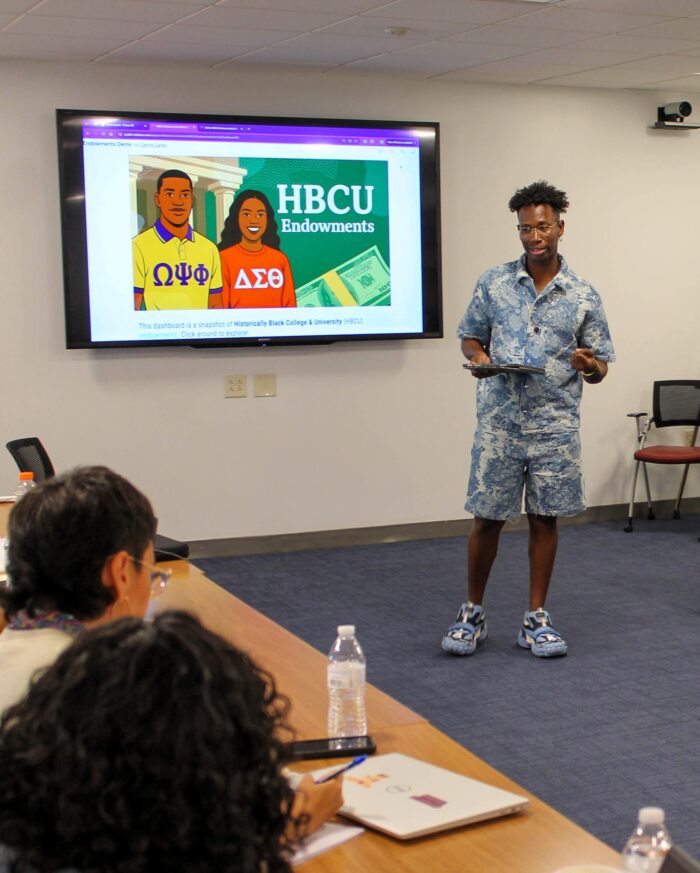
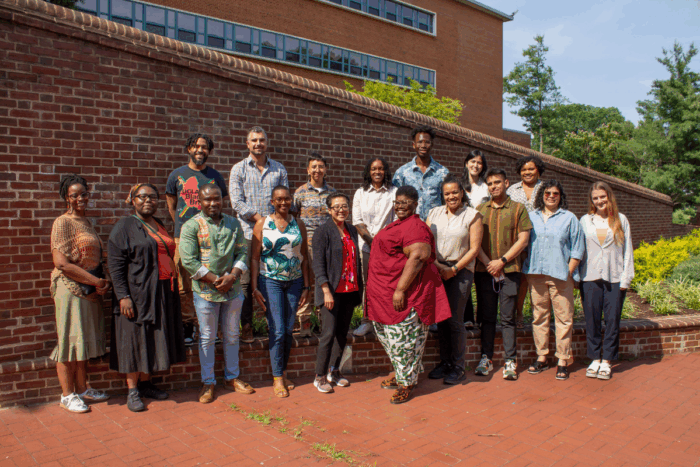
For example, the spring 2025 incubator theme: Collaboratory on Data Storytelling, modelled the transformative potential of learning collaboratively while exploring issues of systemic financial precarity in higher education. Coalescing with an in-person retreat at Howard University, participants explored datasets comparing the endowments of Historically Black Colleges and Universities (HBCUs) and Predominantly White Institutions (PWIs) while navigating how the data visualization platform Tableau Public might transform their scholarship, create avenues for engaging with new audiences, and offer opportunities for advocacy. The retreat’s discussions and workshops were intentionally designed to foreground the pedagogical and communal power of leaning on one another to learn a new skill. But the resulting data stories also underscored various systemic elements of financial precarity within higher education, including the ripple effects that funding cuts at well-resourced PWIs could have on HBCUs. As Kenton Ramsby, Professor of African American Literature and Data storytelling & Visualization Specialist at the Center for Applied Data Science and Analytics at Howard, noted “Our collaboratory created a space where data storytelling became collaborative meaning-making. Each person helped refine the narrative around HBCU endowments, showing how visualizations and context can transform financial data into a call for justice.”
The impact of intentional collaboration when tackling issues of precarity can also be seen in the initiatives funded through the Intention Foundry’s Learned Society Extended Engagement Microgrants. While most projects have limited their activities to individual societies, other projects, such as the PIPES (Publication Improvement Program for Emerging Scholars) collaboration between the African Studies Association (ASA) and the American Society of Eighteenth Century Studies (ASECS), offer a compelling case study of how intentional collaboration can extend the impact of small funds. In identifying and leveraging shared personnel infrastructure, overlapping membership, and virtual convenings, both societies successfully provided opportunities for underrepresented emerging scholars to engage in interdisciplinary exchange and receive mentorship across both learned societies as they navigated publishing their first article. While underrepresented junior scholars were the primary beneficiaries for the project, the initiative’s impact rippled throughout both societies and energized longstanding members. As Benita Blessing, Executive Director of ASECS, noted “It has been so good for [members] to see a public collaboration with another society, and makes them feel like they’re part of something larger than our society and that we’re addressing larger humanities questions in general.”
These efforts within the Intention Foundry do not simply underscore the importance of curated spaces for collaboration, but also bolster a core tenet of the program’s design and administration: if precarity increasingly characterizes the higher education landscape that we navigate—a reality that even those at the most elite of institutions are now experiencing—then collaboration grounded in interdependence, rather than competition, can offer a promising path forward.
Keyanah Nurse
Senior Program Officer for IDEA Programs