


The book reaches well beyond specialist academic audiences by addressing how natural history is collected, organized, and displayed—questions central to museums, contemporary art practice, and public environmental knowledge.
Joanna Page
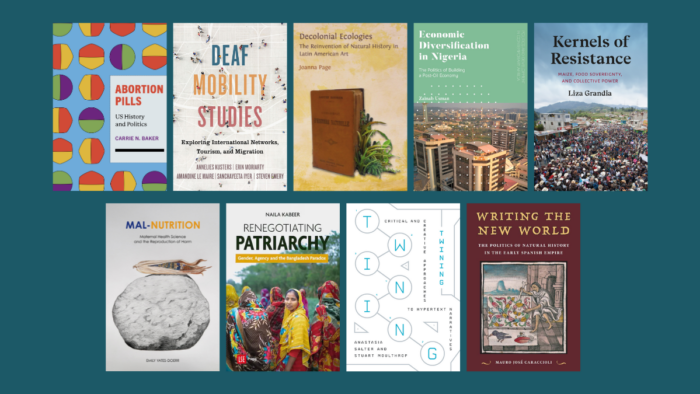
ACLS spoke with the finalists of the 2026 ACLS Open Access Book Prizes and Arcadia Open Access Publishing Awards about their experiences publishing open access. Their answers show how open access expands the reach of humanistic inquiry: their work has shaped policy and legal decisions in real time, reached communities across the globe represented in their research, resulted in invitations to government forums and media interviews, and become a springboard for collaboration in higher education, museums, and beyond. Below, read the impact of their work in their own words.
“The importance of having peer-reviewed information about abortion pills made freely and widely available has only become more urgent as government websites are censored and misinformation proliferates. The book is regularly referenced and linked in Carrie Baker’s public speaking and writing on the topic, and the book was recently cited in the US District Court Western Division of Louisiana and attached as an Exhibit to the brief. Abortion Pills is a shining example of how peer-reviewed, board-approved OA scholarship can impact policy, the courts, and public opinion.”
“One reason we pursued open access publication was that the project on which this book is based (the MobileDeaf project) was highly public-facing, with an established website featuring regular blogs and vlogs, and we wanted the main written output to be openly available as well. We ring-fenced project funding to support open access so that the book could be read by deaf communities, researchers, and the several hundreds of participants whose lives and experiences underpin the research. The main benefit has been significantly wider reach, particularly among students, early-career scholars, and practitioners.
A second key reason was to allow the book to circulate alongside the nine MobileDeaf open access ethnographic films as an integrated resource. A key challenge was the exact way we would integrate film and text, which we addressed by using timecoded links within the wider films and embedding them in the text.”
“The book reaches well beyond specialist academic audiences by addressing how natural history is collected, organized, and displayed—questions central to museums, contemporary art practice, and public environmental knowledge. It has circulated in curatorial contexts: it informed the curation of Archive Alexandre de Humboldt Montréal and featured in associated programming, including the symposium The Humboldt Effect V: Feeding the Fire, which brought university researchers and students together with a wider public.
The research also developed through sustained dialogue with artists undertaking practice-based doctoral projects. The book reflects and advances an ongoing exchange between scholarship and artistic research, contributing to the conceptual development of contemporary practice rather than analyzing it retrospectively.”
The book reaches well beyond specialist academic audiences by addressing how natural history is collected, organized, and displayed—questions central to museums, contemporary art practice, and public environmental knowledge.
“High monograph prices limit access in the Global South. The book has been highly downloaded and has seen substantial print sales in Nigeria and has been repeatedly restocked. Its open availability facilitated policy engagement beyond Nigeria, including invitations for the author to present findings to government and businesses in Guyana, and to serve as peer reviewer and advisory contributor to the Global Economic Diversification Index developed by the Mohammed Bin Rashid School of Government in the UAE, including participation in its inaugural global conference. Open access substantially expanded the book’s policy reach across Africa, the Middle East, and the Western Hemisphere. Open access complemented wider recognition, including by the Financial Times as one of the Best Books 2022.”
“Above all, the goal of writing a comparative book was to cross-pollinate and catalyze conversations between Mexican and Guatemalan food sovereignty movements and learn from one another’s struggles against ‘Monsanto Laws.’
Being able to freely share this scholarship in both countries and elsewhere, through OA publication, Zoom technology, and WhatsApp messaging, allowed me to raise $200,000 and recruit a coalition of twenty molecular biologists, sociologists, lawyers, customs experts, agronomists, biologists, economists, and dozens more grassroots leaders for a binational scientific project to test native maizes for genetically modified contamination in Tabasco and Chiapas and all of Guatemala.”
It was essential not to place my work behind a paywall that would exclude the very people whose expertise and experiences shaped the book. Emily Yates-Doerr
“I pursued open access publication because scholarship about global health inequities should be globally accessible. Mal-Nutrition critically examines nutrition interventions in Guatemala and beyond, drawing on fieldwork with health workers, scientists, and rural communities. It was essential not to place my work behind a paywall that would exclude the very people whose expertise and experiences shaped the book. Open access has also ensured that students and scholars without institutional support can read my work and gain access to the lessons about science and health that it holds.”
“While my initial motivation in pursuing the open access option had been to make the book affordable and available to students, particularly to those in the Global South, I have come to realize that open access makes a difference in the world of policy and practice as well. Policy makers and practitioners always emphasize that they are too busy to read books, but being able to download a book by clicking a link seems to make it more likely that they will read the book.
That is my explanation for why I have been invited to give more presentations to policymakers, practitioner groups, and the general public for this book than any of my previous ones. I have spoken to the Food and Agricultural Organization (Rome), the Population Council (New York), UN Women (New York), the Swedish International Development Co-operation Agency (Stockholm), the Gothenburg Book Fair (Gothenburg), Women in the World Festival (Athens), BRAC (the largest non-governmental organization in Bangladesh), and the UN Gender Equality Group in Bangladesh. Perhaps it is also that the book holds out hope for change, something important in the domain of policy and practice.”
While my initial motivation in pursuing the open access option had been to make the book affordable and available to students, particularly to those in the Global South, I have come to realize that open access makes a difference in the world of policy and practice as well.
“Twining documents and builds upon the labor of an open-source, freely available tool built and maintained by volunteers, and a creative community that values accessibility and inclusion. Publishing behind a paywall would have contradicted those values and made the book potentially inaccessible to those most impacted by the platform. We wanted the book to be available to the same audiences who make and share Twine stories — independent creators, students, activists, and community organizers who may lack institutional library access.”
“In addition to global distribution, open access publication has facilitated a greater number of invited talks, collaborations, reviews, and podcast interviews promoting the work and the profile of the TOME open access initiative. My participation in the program was also featured in a Virginia Tech Center for Humanities roundtable, Open Access and the Humanities: Making Sense of a Sea Change in Scholarly Publishing. Open access is an especially valuable medium for scholars in the humanities to share our work with the world, particularly in times of crisis and isolation.”
The ACLS Open Access Book Prizes and Arcadia Open Access Publishing Awards recognize and reward the authors and publishers of exceptional, innovative, and open humanities scholarship.