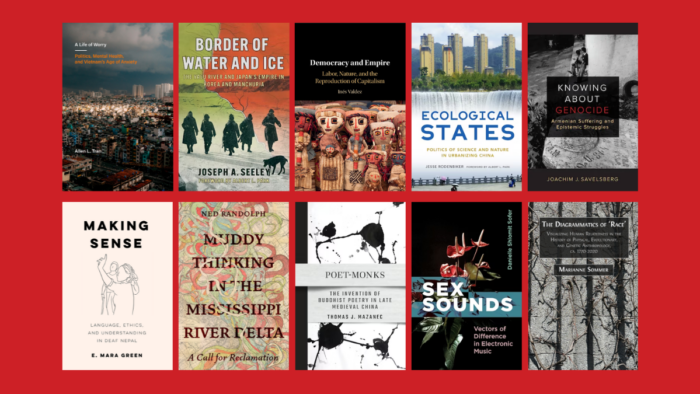
When finalist authors of the 2026 ACLS Open Access Book Prizes explained why they published open access, several themes emerged: reaching audiences outside academia, including communities the book is about or engages with; greater accessibility for readers at under-resourced institutions; easier adoption in classrooms; and wider reach, measured in downloads and countries reached.
Their reflections also speak of a shared ethos that peer-reviewed humanities and social science research should be freely and widely available. The ACLS Open Access Book Prizes and Arcadia Open Access Publishing Awards recognize and reward this critical work through $50,000 awards to the authors and publishers of exceptional, innovative, and open access humanities books published from 2019 to 2024. Below, read the authors’ insights in their own words.
Finalist Category: Anthropology
“Anxiety has become the defining mood and mental health concern of the current moment. I chose open access in the hope that A Life of Worry would be widely assigned for our anxious Gen Z students. I also wanted the book to be accessible to mental health workers in the Global South to offer a way of understanding the rise of anxiety disorders in their own communities that highlights both the promises and pitfalls of Western psychiatry and psychotherapy and invites their own contributions to global conversations about anxiety and what it means to live with uncertainty today.”
Finalist Category: History
“As a first-generation college graduate, I fell in love with the humanities while also being keenly aware of the high barriers to entry (e.g., cost of books and degrees) to pursuing and creating humanistic knowledge. The rise of open-access publishing thus excited me as a means of increasing accessibility to less economically privileged students and aspiring scholars.
Border of Water and Ice has benefitted from open-access publication in many ways, even unexpected ones. Whenever I travel for book talks, I share QR codes and links with friends, family, and community members who might not otherwise purchase an academic monograph but are now eagerly talking to me about seasons, borders, and Asian history.”
Finalist Category: Political Science
“As a scholar, I am less concerned about royalties than about participating in and shaping scholarly and political conversations about—in the case of my book—how western democracies behave imperially, whereas not states but the people and their democratic polities benefit from and intervene on behalf of global capitalism. The instant connectivity of open access means that potential readers trying to access the book on the go can do it, upon hearing a recommendation or listening to a podcast about it.
Open access ensures that that initial impulse to learn more about a subject or incorporate it into an existing project is not hampered by a paywall, which constrains people’s abilities to read the work, even for those with access to the monograph via their library.”

Open access ensures that that initial impulse to learn more about a subject or incorporate it into an existing project is not hampered by a paywall, which constrains people’s abilities to read the work, even for those with access to the monograph via their library.
Inés Valdez
Finalist Category: Environmental Humanities
“Ecological States examines how the Chinese state mobilizes ecological science to justify large-scale displacement that entrenches urban and rural inequalities. Given the sensitivity of this topic, open access is crucial to ensuring the book’s broad availability across mainland China and fostering possibilities for solidarity under authoritarian governance.”
Finalist Category: History
“My 2015 book titled Representing Mass Violence: Conflicting Responses to Human Rights Violations in Darfur was my first OA book. The (back then) close to 8,000 downloads, and well above 1,000 online reads (now close to 9,000 and above 2,000 respectively), encouraged me to also choose an OA format for Knowing about Genocide: Armenian Suffering and Epistemic Struggles, resulting in well above 8,000 downloads and 2,000 online reads since 2021.
This OA publication was appreciated by scholars, while also reaching the intended broader public, illustrated by invitations to contribute to podcasts and to speak to Armenian audiences in the US and at a 2025 international symposium in Oslo that sought to encourage recognition of the Armenian genocide by Norway.”
Finalist Category: Anthropology
“I was excited when UC Press offered the opportunity to pursue open access publication because I knew that doing so would create possibilities for sharing the work more broadly than the traditional, print-only format. Not everyone in my scholarly networks can afford or acquire print copies. This is true across geographical distance as well as locally. The book being available open access makes me feel more comfortable recommending that students, for example, read chapters relevant to their studies.”
I decided to pursue open access publication for the book to encourage its use by students. I continue to meet professors who are teaching the book in a diversity of classroom settings: in landscape architecture, sustainability, and anthropology.
Ned Randolph
Finalist Category: Environmental Humanities
“I decided to pursue open access publication for the book to encourage its use by students. I continue to meet professors who are teaching the book in a diversity of classroom settings: in landscape architecture, sustainability, and anthropology. I’ve heard positive feedback from teachers from around the country that their students really engaged with the work. Many say that they will teach it again. Open access incentivized them to assign it, particularly for students who are financially constrained.”
“I wanted the book to have more widespread availability, especially for overseas readers in East Asia. Also, because my book uses digital methods and large textual databases, an open-access ebook allows me to link directly to these resources. The greatest benefit has been that many people—generalist and specialist readers alike—have been able to read my book who would not otherwise have purchased an academic monograph.”
As a scholar who practices the ethics I advance in my research and publications, I vowed to share the knowledge I uncover freely with the world.
Daniele Shlomit Sofer
Finalist Category: Literary/Media Studies
“As a scholar who practices the ethics I advance in my research and publications, I vowed to share the knowledge I uncover freely with the world.
I could not have anticipated the benefits of open access. First, that the text could reach those for whom the book advocates, artists exploited for their voices and unacknowledged on record—and it has! The download rate demonstrates a wide geographic distribution and suggests the book, though primarily aimed at academics, is popular beyond the university.”
Finalist Category: Anthropology
“I pursued open access publication because this book examines how scientific diagrams have shaped concepts of human difference across centuries—often in ways that continue to influence public discourse. Many of these very diagrams have lately been misused on social media. It felt essential that a study addressing the politics and ethics of such knowledge production in past and present be freely accessible to all. Open access has already broadened the readership far beyond what a traditional academic press could reach.”
2026 Open Access Book Prize Finalists
The ACLS Open Access Book Prizes and Arcadia Open Access Publishing Awards recognize and reward the authors and publishers of exceptional, innovative, and open humanities scholarship.