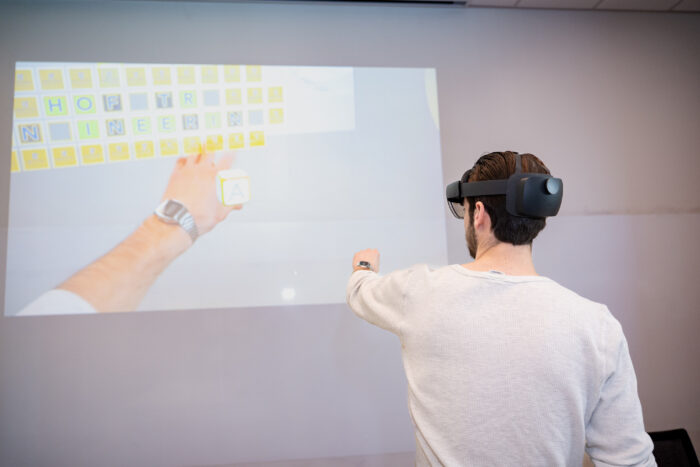
The BA and BS in Human Factors and Usability Studies (HFUS) at Hofstra University’s Fred DeMatteis School of Engineering and Applied Science launched in Fall 2025 with a straightforward mission: “Technology should work for people, not the other way around.”
The program is the result of a two-year development process spearheaded by three founders from different disciplines: Elisabeth Ploran from Psychology; Salvador Rojas-Murillo from Engineering (now the inaugural director); and Lisa DeTora from Writing Studies and Rhetoric. No single discipline owns the HF program; students have an integrated interdisciplinary experience and are able to see collaboration modeled by the program’s faculty.
Hofstra’s Human Factors program recognizes that the most critical challenges in technology today aren’t purely technical problems but human ones. Early market research revealed that most human factors programs tend to be “very technical with a side of human,” as program co-founder Elisabeth Ploran puts it. In contrast, Hofstra’s program places the humanities and social sciences at the center. The program brings together the technical side of engineering and computer science with the social sciences of psychology, design thinking, writing studies, disability studies and ethics to prepare students to be “the person who sees the whole world” on technical teams.
Technology should work for people, not the other way around.
In the earliest stages of development, the program focused on recruiting students who wanted to pursue engineering with a wider perspective. Human Factors attracts students who are drawn to the human-centered side of engineering and design. The program’s first declared major, for example, is combining their Human Factors degree with a minor in Meteorology, with the goal of pursuing weather (especially hazardous event) communications.
The program offers a BS, a BA, and a minor. The BS offers technical rigor with a “lens of humanity.” Ploran describes the BS as suitable for students who want to explore the societal impact of design. The BA and minor focus on communications and aesthetics, but those students must still be technically fluent. The program’s placement in the School of Engineering allows for the recruitment of students transitioning away from traditional engineering. All first-year engineering coursework applies to HF programs as well, but HF requires only pre-calculus, making it more accessible.
A key feature to the Human Factors programs at Hofstra is that accessibility and ethics are woven throughout. All students take Introduction to Disability Studies, where they learn about disability as a social and cultural construct from multiple philosophical, ethical, and legal perspectives. This addresses critical workforce needs, as companies need employees who understand ADA compliance and inclusive design. The Director of Hofstra’s Disability Studies Program, Craig Rustici, has been a key collaborator and supporter. Students also must complete an Ethics and Society requirement, such as “Technology and Human Values.” These courses focus on areas such as engineering ethics, environmental responsibility, and the unintended consequences of technological development.
In addition to these core requirements, students select their electives from a variety of departments, including fine arts (design and visual communication), philosophy (ethics and applied ethics), writing and rhetoric studies (technical communication and UX writing), sociology (human behavior and social systems), and computer science (human-computer interaction and programming fundamentals). Ploran says that the other programs are thrilled about their new student pipelines and excited about the new courses they are able to offer. Although there is some school-based budgeting, Ploran notes that there isn’t much competition between units at Hofstra, but rather a sense that everyone is on the same team. Human Factors creates pathways for engineering students toward humanities and social science disciplines they might not otherwise encounter, and that is regarded as a win for everyone.
Human Factors creates pathways for engineering students toward humanities and social science disciplines they might not otherwise encounter, and that is regarded as a win for everyone.
From the beginning, the programs’ co-founders emphasized industry careers for their graduates. They launched the program in April 2025 with a summit that showcased some of the program’s diverse real-world applications. Students will also be well-prepared for graduate work in interdisciplinary fields such as human-computer interaction, design, and accessibility.
Although the program is still very young, there is a great deal of student excitement. Examples like the HF/Meteorology major/minor combination suggest applications that even the program founders haven’t thought of. The program demonstrates that combining engineering and the humanities/social sciences strengthens both, creates career pathways for students in growing fields, and addresses critical societal needs, such as inclusive design and technology for an aging population.
Key Takeaways
-
- Listen to students and do market research. The program grew out of a recognition that there were some students in engineering who wanted more emphasis on people or society and less focus on the purely technical. Combined with market research into other HF programs, this understanding allowed Hofstra’s program to differentiate itself by centering humanities and social science content.
- Beware territorial tendencies. In a different institutional context, arguments over whether to house the program in engineering or psychology could have affected the program’s ability to recruit students who were exploring or leaving engineering tracks. However, Hofstra’s “team” mentality and willingness to share students across departments and disciplines set everyone up to benefit from the new program.
- Career outcomes and industry connections matter. Program founders didn’t assume that there would be a job market for their graduates. They brought in industry partners and successful alumni early through the launching summit to lay the groundwork for future relationships, and they clearly articulated possible outcomes to interested students.
Building Blocks for a New Academy
A community for sharing and uplifting the work of creating more just, humane, and innovative colleges and universities