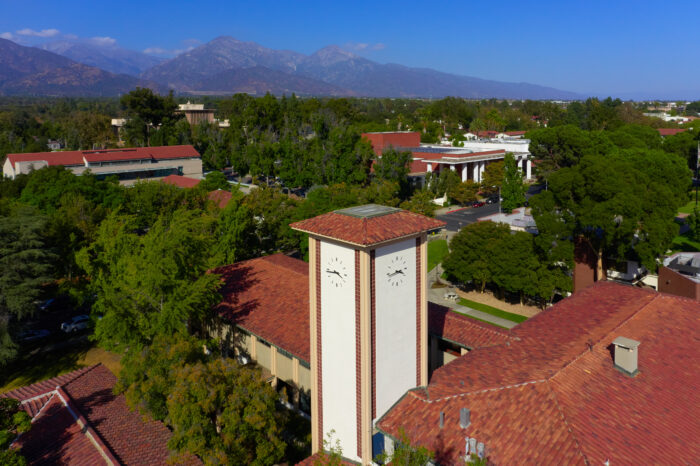
In the past five years, the Center for Humanities in Practice (CHIP) at Claremont Graduate University (CGU) has quietly but significantly grown the enrollment of a number of its “humanities in practice” programs. This growth is largely due to the cultivation of strong relationships with local partners and a philosophical emphasis on the importance of the humanities in any career.
CHIP maintains five graduate programs:
- Museum Studies (interdisciplinary concentration)
- Archival Studies (interdisciplinary concentration or can be combined with History for a Master’s)
- Media Studies (interdisciplinary concentration)
- Applied Gender Studies (Master’s)
- Arts Management (Master’s)
All five, whether they are Master’s degrees or concentrations, have a philosophical core that is about “practice.” According to Center Founder and Director and Professor of Cultural Studies and History Josh Goode, the idea of “humanities in practice” is not about applying the humanities in specific contexts but about showing that humanities skills can enhance any career or institution, from museum work to coding to engineering.
“Humanities in practice” is not about applying the humanities in specific contexts but about showing that humanities skills can enhance any career or institution, from museum work to coding to engineering.
This practice-based approach to humanistic training began fourteen years ago within Museum and Archival Studies but has gained a lot of momentum in the last five years. Currently, twenty-five percent of all humanities graduate students at Claremont are enrolled in programs under CHIP, and its museum studies classes, in particular, tend to be over-enrolled. It also offers accelerated Master’s pathways to students at SUNY Geneseo and the University of La Verne, in addition to those at the Claremont colleges.
Out of all the programs, the Museum Studies concentration provides the clearest model for others. Museum Studies doesn’t have a required internship as Archival Studies does, but about 50% of all Museum Studies students do an internship anyway. Goode has tried to shift the language of the Center away from “internships” and toward that of “consultancies.” CHIP’s partners – both at places such as the Benton Museum or the Wende Museum and at private companies like Farmer’s Insurance – discover that they are essentially hiring junior staff to address real institutional and organizational needs. In some cases, partner organizations contribute funds to the internship; other funds are contributed by the Mark Chapin Johnson Foundation, which provides 2-3 $9,000 stipends per year for 6-9 month positions.
Over time, CHIP has developed recurring consulting positions. Two Museum Studies students serve each year as the executive directors of small campus museums, such as the Paul Gray Personal Computer Museum and Peter Drucker House. A board consisting of Goode, other faculty members, and community stakeholders provide governance and a pedagogical function as the students navigate challenges and opportunities. These small organizations provide space for students to experiment with sufficient oversight and support.
Other students have pursued internships in local museums. One such student, Matthew Jones, a PhD Candidate in Cultural Studies and Museum Studies, completed an internship with a small Cold War museum that turned into a full-fledged job. Jones says, “I’ve gained a really deep understanding of museums not just as cultural objects or texts to be studied, but also their inner workings as institutions. […] I feel really equipped to enter the job field after I graduate.” Museum Studies students have gone on to positions in a range of well-respected organizations, such as The Getty Museum, the Wende Museum, the Autry Museum of the West, and the Museum of Contemporary Art.
I’ve gained a really deep understanding of museums not just as cultural objects or texts to be studied, but also their inner workings as institutions. […] I feel really equipped to enter the job field after I graduate.
Matthew Jones, PhD candidate in Cultural Studies and Museum Studies, CGU
As a graduate-only institution, CGU faces certain challenges. There is a limited administrative infrastructure, and the programs require external funding to sustain. As of now, there is little formal alumni tracking, though Goode is working to systematize this. The model requires active “tending” by someone, as relationships with partner organizations are key to its success. The strength of those relationships in the museum and archival sectors are reflected in the corresponding strength of those programs, but they require cultivation and management to sustain.
In the next few years, Goode would like to consider new pathways for the doctorate, including what a professional humanities doctorate might look like. He would like to expand the consulting model into the business world and expand an “executive in residence” program to bring mid-to-late career business people into the university. At a moment when many are asking whether the humanities have a future, Claremont Graduate University’s Center for Humanities in Practice suggests a different question: not whether the humanities have value, but whether our programs are helping students — and the world — see where that value already exists.
Key Takeaways
-
- Reframe your language to expand possibilities. Moving from “applied humanities” to “humanities in practice” opens up what counts as relevant work. Similarly, moving from “internships” to “consultancies” emphasizes the expertise that grad students bring to real institutional needs.
- Create safe spaces for risk-taking. Small campus museums or modest community partnerships allow students to lead projects without high stakes. Build scaffolding through board structures or advisors who can turn challenges into learning.
- Joint funding creates true partnership. Bringing resources with you can make building partnerships easier. But even small financial contributions from partners signals investment in students’ work and creates more equitable relationships.
- The model is transferable, but requires active cultivation. CHIP’s success depends on sustained relationship-building and program management. Identify who will “tend the shop” before launching similar initiatives, and be willing to experiment and adjust.
- Document your success. Make sure that others are aware of what you’re building and that it is working. The humanities have been under stress for so long that people assume this to be true of all humanities programs. If your program is thriving, make sure you document your successes and share them with others.
- Think creatively about curricular possibilities. Bringing practitioners in to teach practice-based classes provides professional role models for students and professional value to practitioners.
Building Blocks for a New Academy
A community for sharing and uplifting the work of creating more just, humane, and innovative colleges and universities