

ACLS President Joy Connolly 2026 Speaking Engagements
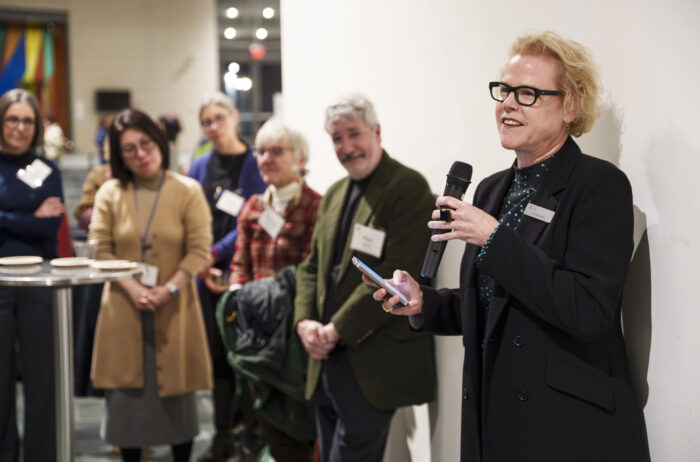
ACLS President Joy Connolly is a celebrated scholar of ancient Roman rhetoric and political thought and their enduring influence in modernity. She is also a thought leader on the future of the humanities and fostering what we call the “new academy”—where a vibrantly curious professoriate can pursue scholarly inquiry with creativity and a sense of wonder; where collaboration and mentorship are valued; and where faculty are rewarded for their efforts to connect with an emerging generation.
She speaks and writes regularly on these topics and will be featured at the following public events in 2026:
Tuesday, November 17
Simpson Center for the Humanities Lecture
University of Washington: Seattle, Washington
Joy Connolly will visit the University of Washington’s Simpson Center for the Humanities to give an invited talk for faculty in the humanities and humanistic social sciences from across campus. The visit will include conversations with scholars, university leaders, and colleagues in Classics, exploring the role of the humanities in higher education and public life.
Monday, November 16, 10:00-11:30 am EST
Literature Humanities Lecture on Virgil’s Aeneid
Columbia University | New York, New York
Joy Connolly will give a lecture on Virgil’s Aeneid for instructors in Columbia University’s Literature Humanities program, the university’s foundational literature seminar. Her talk will explore the significance of Virgil’s epic and its role in humanistic education and core curricula.
Monday, October 5
Policy Roundtable on Democractic Backsliding and Resilience
University of Oxford
Joy Connolly will participate in the 2026 Policy Roundtable on Democratic Backsliding and Resilience, convened by the University of Oxford and Democracy International. The roundtable will bring together leaders from higher education, law, government, business, and civil society to explore strategies for strengthening democratic institutions, academic freedom, and civic resilience.
Tuesday, June 9, 6:00 – 7:30 pm BST
Creighton Lecture 2026 – Political Life and Political Crises: A Conversation with Joy Connolly, Melissa Lane, and David Cannadin
Institute of Humanities Research, University of London
How can democratic life survive amid the global rise of authoritarianism and deepening inequality? As political norms and systems of communication come under increasing pressure, how might people and institutions respond? And how might practices of citizenship develop in the future? This event brings together Joy Connolly, Melissa Lane, and David Cannadine in conversation chaired by Philip Murphy, Director of History & Policy at the IHR, to reflect on political life and political crises. Drawing on the panelists’ expertise in ancient Greek political theory, Roman ideas about politics, and the emergence of mass democracy in Europe, this discussion will bring historical depth to contemporary challenges, and address some of the most pressing issues that we face today.
Speakers:
- Professor Joy Connolly has been ACLS president since 2019. She is a classicist by training and works on history of Roman political thought and rhetoric. Connolly has also written on the future of ancient studies in the context of global ancient history and the role of humanities in public life.
- Professor Melissa Lane, currently Gresham College’s Professor of Rhetoric, recent ICS Visiting Fellow, and former director of Princeton’s Centre for Human Values, has a particular interest in ancient Greek political thought. Lane also works on the ethics and political theory of climate change, and more broadly, the intersection between science, democracy, and communication.
- Professor Sir David Cannadine, former Director of the IHR, has interests that range widely across the economic, social, political and cultural history of modern Britain and its empire, capitalism, collecting and philanthropy in nineteenth and twentieth century America, and the history of history. Cannadine is editor of the Dictionary of National Biography, Chair of Trustees of the National Portrait Gallery and has served as President of the British Academy and vice-president of the Royal Historical Society. Alongside his historical research he appears regularly as a commentator on current affairs.
The 2026 Creighton Lecture is jointly organized by the Institute of Classical Studies and the Institute of Historical Research.
Tuesday, June 9, 1:30 pm – 2:45 pm BST
Defending the Arts, Social Sciences and Humanities
Warburg Institute, Woburn Square, WC1H 0AB
What does it take to champion humanities knowledge and approaches in a rapidly changing world? What lessons can we learn from the American advocacy landscape, and what does the future hold for the arts, humanities and social sciences. Join this timely transatlantic conversation about how we can defend, celebrate and secure the future of the arts, humanities and social sciences. Joy will discuss her recently launched initiative Defending the Arts, Social Sciences and Humanities and share insights from her many experiences advocating for the humanities. Joy will be joined by Professors Emma Cayley and Thea Pitman, Co-chairs of the Arts and Humanities Alliance; and Sarah Cowan, Head of Higher Education and Research Policy, British Academy. Dr Kathryn Tempest, Acting Director of the Institute of Classical Studies and Chair of the University Classical Departments, will chair the discussion. This event is organised by the School of Advanced Study and the Consortium of Institutes of Advanced Study.
Wednesday, June 3, 9:15 am – 10:15 am
Instant Classics Podcast: “The United States and its Roman Inheritances”
Recorded online (Riverside studio)
Joy Connolly joins Charlotte Higgins and Mary Beard for an episode of the Instant Classics podcast exploring how Roman political ideas, symbols, and institutions have shaped the imagination of the United States. The conversation begins from familiar cultural touchpoints—the Roman echoes in American civic architecture, the language of the Senate and Capitol, and modern political spectacle—and moves into deeper questions about republican thought, rhetoric, and civic life. Drawing on her scholarship in Roman political thought and rhetoric, Professor Connolly reflects on how ancient writers like Cicero understood civic responsibility not as abstract principle but as something formed through habits, language, and embodied public life. The discussion also considers how Roman republicanism has been selectively adopted, reinterpreted, and at times distorted in American political culture, from the founding era to the present. The episode is recorded remotely with production support from Red Room Poetry, and is followed by audience questions and wider reflection on the enduring uses—and misuses—of classical antiquity in contemporary political debate.
Thursday, May 28, 7:00 – 8:30 pm BST
The Newell Classical Event Talk: ‘Meeting the conditions of freedom: Roman political thought in an age of tyranny and greed‘
St. John’s College, University of Cambridge
A leading US academic will explore what ancient Rome can teach us about freedom, civic life and political responsibility at the Newell Classical Event. Professor Joy Connolly, a professor of Classics and President of the American Council for Learned Societies (ACLS), will give this year’s Newell Classical Event talk, Meeting the conditions of freedom: Roman political thought in an age of tyranny and greed. The lecture will be followed by a conversation on the issues it raises with Dr Shushma Malik, Associate Professor of Classics at the University Cambridge, ahead of an audience Q&A. The annual Newell Classical Event was established in 2015 following a generous bequest from a St John’s alumnus. The aim is to celebrate all that is exciting, creative and forward-thinking in the world of Classics, and bring it to the attention of a wide public. For many people today, preoccupied with individual wellbeing and the flaws of democratic politics, Roman republican political thought offers a bracing view of human interdependence and identity. In her talk, Professor Connolly will concentrate not on abstract principles but on the embodied experiences and habits of thought that thinkers like Cicero viewed as crucial for civic thriving – proof of the value of the ancient archive as a resource for alternative thinking. The Newell Classical Event 2026 will take place in the Palmerston Room, Fisher Building, St John’s College, on Thursday 28 May, 7-8.30pm. Members of the public are welcome to attend and booking is not required.
Monday, April 27, 4:00 – 6:00 pm CST
Kaplan Critical Conversations in the Humanities with Joy Connolly and Marwan Kraidy
Alice Kaplan Institute for the Humanities, Northwestern University
The Kaplan Institute has invited Joy Connolly to speak at the Spring 2026 Kaplan Critical Conversation in the Humanities at Northwestern University. She will be joined in conversation by Marwan Kraidy, Dean of Northwestern University in Qatar and Chair of the ACLS Board of Directors. The event continues the Institute’s campus-wide Kaplan Keynotes series, which brings leading scholars into dialogue on the role of the humanities in addressing urgent contemporary questions. Prior conversations in the series have explored themes such as race and caste, mass incarceration and art, translation and cultural exchange, and the politics of knowledge and truth. This conversation will focus on the promise of the humanities in the present moment, with an emphasis on developing affirmative, forward-looking narratives about their value in public and institutional life. The discussion will also draw on Joy Connolly’s work at ACLS in shaping the broader ecosystem of humanistic scholarship across universities, learned societies, and public-facing institutions. Joy Connolly and Marwan Kraidy have previously discussed this collaboration in the context of their ongoing work together at ACLS. The event builds on that partnership and reflects their shared interest in strengthening the public standing and institutional support for the humanities.
Monday, April 13, 3:50 – 5:00 pm CEST
Fiesole Retreat, Speaker on Does Reading Matter (Anymore)? Panel
University of Tübingen
In this session, panelists will pursue the question – “Does Reading Matter Anymore?” There’s more to read than ever, our phones are distracting us from reading, and the Large Language Models are prowling around the world reading everything in sight and preparing to show off just how much better they are at the task than humans have ever been. There seems to be less time to read than ever before, and we are seduced by avatars who might do our reading for us. Let us examine more deeply just what’s going on and how librarians, publishers, and academics might think about it? The session will combine research-driven examination of current developments with open-ended imagination and provocation about what this revolution will do to us. Joy’s talk, titled The Arts of Attention and Invention, will touch on corporate forces of news media and social media present human reliance on AI as a fork in the road. Some will say yes to Large Language Models and join in the imminent transformation of work, knowledge, or human life; others will say no and become nostalgic defenders of a lost age. “There is no alternative,” as Margaret Thatcher liked to say of capitalism. She will talk about the ways humanists are confronting LLMs in real life – with nuance, with alternatives, and with keen awareness of our need to articulate the value of the skills imparted by reading and writing that LLMs cannot replace, including sustained attention and creative invention (the first step in forming an argument in ancient rhetorical education).
Wednesday, April 8, 2:00 – 3:15 pm EST
College of Arts and Sciences Visit & Talk
Bentley University, Waltham Massachusetts
Thanks to outreach from Johannes Eijmberts, Director of the Valente Center for Arts & Sciences at Bentley University and Jennifer Brown, new Dean of Arts & Sciences, Joy has been invited to speak to the humanities faculty on why the humanities matter today and how to shape an affirming narrative about their future. The discussion is not framed as an emergency intervention, but rather as an opportunity to articulate a forward-looking account of the humanities in a rapidly changing institutional and public landscape. The conversation will open with Jennifer Brown raising broader questions about current institutional pressures, including litigation and accountability frameworks shaping higher education. They will also discuss the role of the humanities in relation to contemporary challenges such as AI, digital humanities, and the intersections between business, entrepreneurship, and humanistic inquiry. The session will engage recent work in the field, including the 2025 ACLS Open Books Prize winner in the Multimodal category: Feral Atlas: The More-Than-Human Anthropocene by Anna L. Tsing, Jennifer Deger, Alder Keleman Saxena, and Feifei Zhou. Joy first connected with Johannes Eijmberts at the ACLS regional gathering at Cape Cod in September 2025.
Saturday, March 14, 10:30- 12:00 pm CST
Roundtable Discussion: Polarization and Politicalization: o tempora, o mores
The Classical Association of the Middle West and South (CAMWS) Annual Meeting, Mobile Alabama
Partisan rancor can make it especially difficult to balance academic freedom with the expectations of accountability—some reasonable, but some inflated—that characterize our times. Our field gives us an invaluable perspective on this atmosphere of politicized polarization. Authors like Virgil and Aristophanes, Plato and Cicero, lived in eras of profound uncertainty and civil upheaval that in many ways mirror our own. Their explorations of moral and political complexity, along with the ever-evolving tradition that seeks to recover less prominent voices, can offer guidance and hope as we navigate these troubled waters. Our session will begin with opening remarks from a classicist who during the course of a distinguished career has dealt creatively and forcefully with these and other matters. After describing the lay of the land, she will invite a range of classicists to offer their own thoughts, based on their own experiences. These individuals (associated with a range of institutions) will discuss constructive steps they have witnessed and/or helped inaugurate. Following the responses from the panelists, the first speaker will invite audience members to participate in our conversation.
Saturday, March 7, 5:00 – 6:00 pm PST
Fireside Chat with Joy Connolly and Gabi Starr, Pomona College President
Pomona College Trustee-Faculty Retreat, Newport Beach CA
In a Saturday evening fireside conversation with President Starr, Dr. Joy Connolly will explore the future of the liberal arts and how colleges can prepare students for a rapidly changing world. Drawing on her leadership in national higher education initiatives, she will reflect on how a liberal arts education cultivates habits of attention, critical inquiry, listening, and evidence-based reasoning, capacities that remain essential even as new technologies reshape learning and knowledge creation. The discussion will consider how institutions can sustain their core mission while adapting to new professional pathways, engaging broader communities, and educating the whole person for civic and professional life. The conversation will consider how colleges can innovate while remaining grounded in their values, encourage curiosity and understanding across differences, and extend their impact beyond campus in a rapidly changing social and political landscape.
Thursday, January 29, 1:30 pm – 2:30 pm EST
Beyond the Ivory Tower: The Real-World Importance of Open Access Today
Open Access Scholarly Publishing Association (OASPA)
Open access advocates routinely proclaim the importance of information as a public good. Access to information and knowledge has been codified in the UN Declaration of Human Rights (Article 19). But what is actually happening on the ground? Does it matter that we make scholarly research open to those beyond academia? Who else is finding, reading and benefitting from open content? Where are they and what are they doing with the information? In short – why do we care about opening up access to scholarship? And what is the risk of not having this content openly available? At a time when the relevance of taxpayer-funded research at universities and other institutions is being questioned and debated, this session will include perspectives from four US-based speakers. Panelists will explore not just how open access contributes to the general information environment, but if and how open access can serve as a force multiplier in this current period of destabilization and uncertainty. OASPA’s first webinar of the year will focus on outlining why access to research matters in the real world with moderator Ameet Doshi (Princeton University Library) and panelists Joy Connolly (American Council of Learned Societies (ACLS), Beth Daley (The Conversation, US), and Lacey N. LaGrone (UCHealth Medical Center of the Rockies, Colorado).
Thursday, January 22, 3:45 pm – 4:45 pm EST
Humanistic Inquiry for the Public Good: The Law in College Classrooms and Research Agendas
The American Association of Colleges and Universities (AAC&U) Annual Meeting, Washington DC
Joy joins Michael Cooper, Executive Director and Executive Vice President, American Society of International Law; Stacy Leeds, Dean and Professor of Law, Arizona State University; Laura Nielsen, Research Professor and Professor of Sociology, American Bar Foundation, Northwestern University; Kellye Testy, President and Chief Executive Officer, Law School Admission Council on this panel at the AAC&U Annual Meeting. The panel will feature a diverse group of experienced leaders of prominent academic professional societies, national organizations, and law schools. The speakers will lead a discussion on the advantages of integrating the study of law and related areas into undergraduate programs and offer concrete suggestions about best practices in doing so. Benefits to be probed include educating students for effective democratic participation, providing a range of practical career pathways, and building the future pipeline of lawyers who are charged with defending liberty and pursuing justice.
Thursday, January 22, 2:00 pm – 3:15 pm EST
Collaboration as an Essential Strategy in Challenging Times
The American Association of Colleges and Universities (AAC&U) Annual Meeting, Washington DC
Joy joins Paula Krebs, Executive Director, Modern Language Association; Steed Davidson, Executive Director, Society for Biblical Literature; Frederick Lawrence, Secretary and CEO, Phi Beta Kappa; Sarah Weicksel, Executive Director, American Historical Association on this panel at the AAC&U Annual Meeting. The flurry of Executive Orders and the actions of the Department of Government Efficiency (DOGE) have inspired a level of collaborative resistance that is new across higher education. This panel, featuring brief presentations leading to extensive audience engagement, will focus on various strategies for collaboration across higher education associations as ways to resist more effectively the attacks on the humanities, higher education, and academic freedom. The participants’ organizations are engaged in a number of efforts, including cooperative professional development programs, national organizing on graduate education, group efforts in support of academic freedom, and a lawsuit against the government. We work with campuses and with individual faculty and graduate student members, facilitating collaboration at many levels. The leaders of the organizations will engage audience members in a discussion of collaborations in which we are engaged, encouraging campuses, organizations, and faculty member groups to work across boundaries to develop more effective resistance strategies.