A Message from Daphne Weber, ACLS Program Officer of Buddhist Studies
Published: February 11, 2026
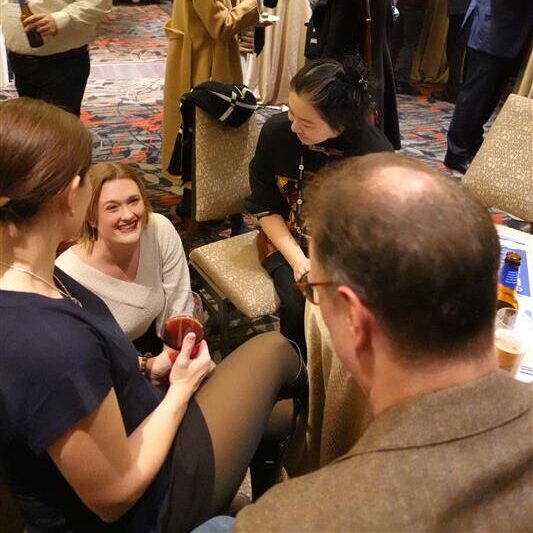
ACLS Program Officer Daphne Weber visits 2025 Buddhism Public Scholar Tierney B. Brown at the American Museum of Natural History
I recently described myself as a ‘nonprofit scholar’ at a convening of Buddhist Studies scholars. I was a bit surprised by my own description, as it deviated from my typical elevator pitch introducing myself as the Buddhist Studies Program Officer at ACLS and a brief overview of my research. In that instance, however, I wanted to signal that I have maintained my scholarly identity alongside my alt-academic position as a Buddhist Studies Program Officer with ACLS.
My research with Thai Bhikkhunīs (female monks) and their ordination process included extensive participatory fieldwork, bringing me into direct relationship with the people at the heart of my scholarship. Prior to joining ACLS, in addition to my research and writing, I taught courses in anthropology incorporating theories from gender studies and psychology and regularly participated in an advisory capacity on regular study abroad trip to Thailand. When I came across the Buddhist Studies Program Officer job description, the preference for community-engaged experience immediately stuck out to me not only as an element I wanted to emphasize in my next professional chapter, but that I wanted to see more in this field based on my interdisciplinary training.
Since starting this position in August 2024, I have had the privilege of conducting more than 30 interviews with Buddhist Studies scholars about community-engaged research. What does ‘community’ and ‘engaged’ mean? Does ‘community-engaged research’ take on a different connotation in our field? How have we seen community-engaged research in Buddhist Studies, and how might we build it out as a methodology and practice for scholars?
The interviews led to the creation of four focus groups, each addressing a topic on ‘community-engaged research’ in Buddhist Studies: Methodologies, Monastic-Scholars, Translations, and Biases. One theme consistently emerged from the interviews and the focus groups: scholars want to engage in public scholarship, but they are uncertain how to do it. Those who were interested in or actively involved in this form of scholarship often reported not receiving institutional training, support, or recognition for these activities. They were caught between the expectations of a ‘publish or perish’ career path and a pull toward public engagement.
This tension, though not specific to Buddhist Studies, is at the heart of what we are building in The Robert H. N. Ho Family Foundation Program in Buddhist Studies at ACLS. You may have noticed that we have launched several new initiatives alongside our established competitions over the past year and wondered “why now?” The answer is we are trying to support scholars across the full spectrum of what Buddhist Studies is and can be.
In my capacity as a Program Officer with ACLS, helping to build a field means creating the infrastructure to recognize and support all the ways scholars do meaningful work, especially as a scholar myself.
With renewed commitment from The Robert H. N. Ho Family Foundation Global in 2024, we’ve grown the program to reflect shifting priorities for the field. Dissertation Fellowships and Early Career Research Fellowships continue to support rigorous, curiosity-driven research by emerging scholars in the field. The Buddhism Public Scholars program has been expanded to include international host organizations, increasing access to scholarly expertise in Buddhism to museums, libraries, and publishers around the world. The new Public Impact Grants encourage scholars to consider how their research might support the initiatives and interests of Buddhist practitioners, monastics, and heritage members, especially through collaboration. The New Professorship Grant continues to seed Buddhist Studies faculty positions and curriculum at colleges and universities that have none, creating job opportunities for Buddhologists worldwide. Finally, the new Global Buddhism Series with Yale University Press will create publication pathways for fellows whose work ACLS has supported.
None of these programs or initiatives emerged in a vacuum. They came from listening to scholars describing what they need to do meaningful work. But perhaps the most important aspect of the Buddhist Studies program is our commitment that fellows and grantees do not simply receive their award and only check in when their reports are due. Instead, we invite them to participate in new training opportunities and ongoing convenings to strengthen their networks. Most notably is our annual Early Career Buddhist Studies Retreat that celebrates junior scholars’ accomplishments, facilitates professional and research development workshops, and creates networking opportunities with peers and senior scholars in the field from around the world. Over the past year, we have also organized social receptions at the annual meetings of the American Academy of Religion and the Association of Asian Studies to further encourage celebration and networking among our awardees, partners, and collaborators.
In my capacity as a Program Officer with ACLS, helping to build a field means creating the infrastructure to recognize and support all the ways scholars do meaningful work, especially as a scholar myself. Buddhist Studies is among the largest field-building programs at ACLS, and that scope creates genuine opportunity to build lasting relationships between scholars and practitioners across career stages and institutions. The result is a growing network rooted in rigorous academic research that reaches far beyond the university: For example, 2025 Translation Grantees Venerable Jampa Gyeltsen and Jed Forman are collaborating on a project that promotes Tibetan scholarship; 2025 Dissertation Fellow Kirby Sokolow is exploring Buddhism in US prisons via archival research, media analysis, and oral history; 2023 Dissertation Fellow Thupten Kelsang continues to organize critically important conversations around cultural heritage and decolonization; and 2022 Dissertation Fellow Donagh Coleman’s documentary film Tukdam: Between Worlds has been screened at a number of international film festivals and even won an award at the Aravali International Film Festival.
The programs, convenings, and international networks sustain a field that supports an incredibly wide range of engagement with Buddhist Studies. From introducing undergraduates to the academic field of Buddhist Studies (even introducing them to His Holiness the Dalai Lama during a Simpson College study abroad trip), to creating positions for Buddhologists worldwide (especially one which resulted in a Global Buddhism graduate program geared toward monastics and nuns at Rajamangala University of Technology Krungthep), we aim to support scholars of Buddhist Studies through all phases of their career, and to make their research visible and accessible to interested practitioners and institutions. Bringing our scholarship to expanded audiences only demonstrates the importance and value of our work. As a ‘nonprofit scholar’ who is deeply invested in both the research and the institutional work that sustains it, I am proud to support the many ways scholars are advancing our field.
Daphne Weber ACLS Program Officer of Buddhist Studies