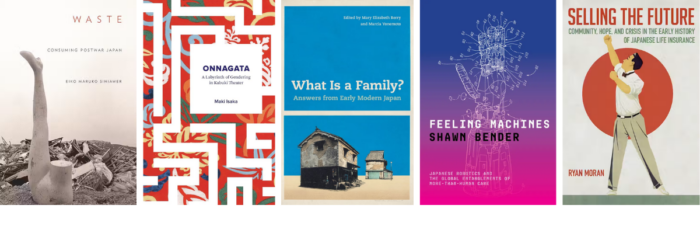
In the past 15 years, the American Council of Learned Societies (ACLS) has funded more than 100 scholars focusing on Japan Studies. These scholars have dedicated time to rigorous research that has expanded understanding of Japanese language, history, culture, society, global impact, and more.
One focus of this research is how Japanese ideas about the family unit and gender have changed over time. Scholars’ work uncovering these histories helps us understand modern-day debates about the Japanese system of family registries (or koseki). Established in 1871, the family registry records the identity and lineage of all Japanese nationals based on their family unit.
In recent years, the registry has faced increasing legal challenges, including challenges to the requirement that married couples use the same surname. The requirement has drawn concerns about gender equality, particularly for women who have built a professional and financial identity around their maiden name by the time they marry. Sanae Takaichi, elected as Japan’s first female prime minister in October 2025, has recently put the surname requirement in the headlines because of her opposition to allowing couples to register different surnames, on the grounds that this would undermine family unity.
ACLS recently spoke with three fellows about how Japanese ideas about family and gender have shifted over the past century and a half.
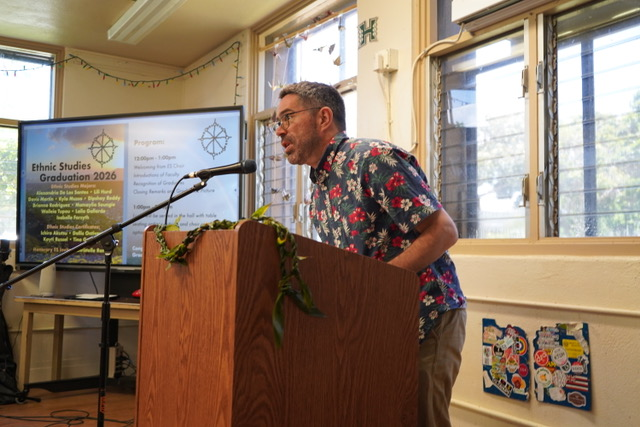
Ryan Moran at 2026 University of Hawai’i at Mānoa graduations for the Ethnic Studies department
“While the importance of the multigenerational family would continue for some time, life insurance helped to promote an ideal of individual responsibility for the patriarchal male household head,” explained Moran, Assistant Professor of Ethnic Studies at University of Hawaiʻi at Mānoa. “Life insurance salesmen sold and promoted this vision of a responsible patriarch of a nuclear family to an emerging class of urban, white collar workers in the first decades of the twentieth century.”
Marcia Yonemoto, Professor of History at University of Colorado, Boulder, is writing a book on the history of adoption in Japan, particularly the practice of adopting adult sons-in-law, with the support of a 2019 ACLS Fellowship. She is also the co-editor of What is a Family? Answers from Early Modern Japan(University of California Press, 2019).
“The history of adoption in early modern Japan clearly shows how the needs and interests of the corporate group that is the family (ie) outweighs the needs and interests of any of its individual members. If a family had no biological sons (or even if they did, but the son or sons were deemed incompetent or otherwise unsuitable) they could adopt a son and make him their heir,” said Yonemto.
Even today, the overwhelming majority of adoptions in Japan (some 95% of all adoptions) are of adults, for heirship. Both the form and frequency of adoption enabled the durability of the ie system and led to distinct yet flexible concepts of family and relatedness in Japan.
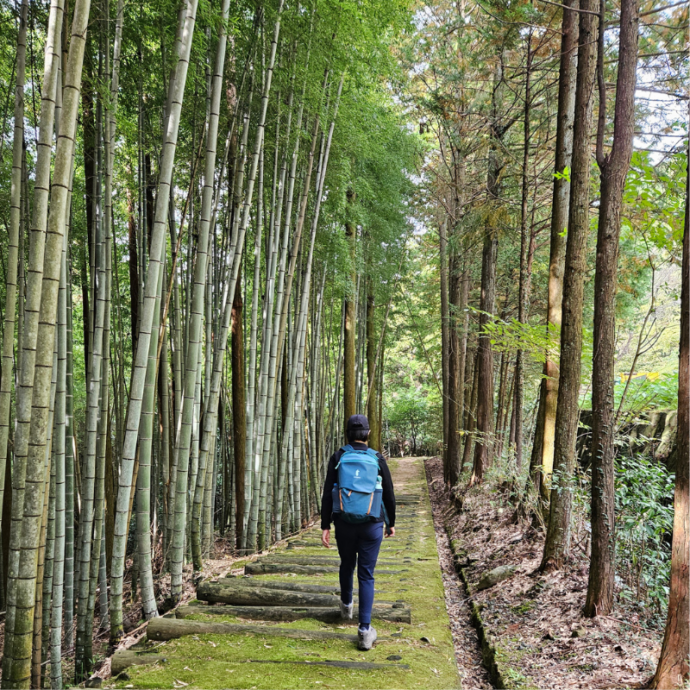
Marcia Yonemoto
Image: Yonemoto hikes on the Hagi Ōkan in western Honshu. This area was governed by the Mōri family, who figure prominently in her forthcoming book on the history of adoption and family formation in Japan from 1550-1912.
Maki Isaka, a specialist in gender studies and Japanese theater who teaches at the University of Minnesota, had the support of a 2006 ACLS Charles A. Ryskamp Research Fellowship award as she wrote her book Onnagata: A Labyrinth of Gendering in Kabuki Theater (University of Washington Press, 2016). She was also awarded a 2017 ACLS Fellowship for her project on female chanters in the Japanese bunraku puppet theater. Her book examines how onnagata, typically male actors who perform the roles of women, have shaped the concepts of femininity and gender in Japan since the seventeenth century.
Moran, Yonemoto, and Isaka each study a different corner of Japanese history and culture, but together their work shows how humanistic inquiry provides critical context to current policy and cultural debates in Japan and around the world.
Explore more scholarship that ACLS has funded in Japan Studies below.
ACLS-Funded Research in Japan Studies
Books
How Buddhism Spread in Japan, 650–850
How Buddhism Spread in Japan, 650–850
University of Hawaiʻi Press, 2026
Written by Bryan D. Lowe, 2020 Robert H. N. Ho Family Foundation Research Fellow in Buddhist Studies, Director of Undergraduate Studies and Associate Professor of Religion, Melanchton W. Jacobus University Preceptor, Princeton University
Kyoto Visual Culture in the Early Edo and Meiji Periods
Kyoto Visual Culture in the Early Edo and Meiji Periods: The arts of reinvention
London: Routledge, 2016
Co-edited by 2012ACLS fellow Alice Y. Tseng, Associate Dean of the Faculty, Humanities and Professor of History of Art & Architecture, College of Arts & Sciences, Boston University, with Morgan Pitelka
Modern Kyoto: Building for Ceremony and Commemoration, 1868-1940
University of Hawai`i Press, 2018
Written by 2012 ACLS fellow Alice Y. Tseng, Associate Dean of the Faculty, Humanities and Professor of History of Art & Architecture, College of Arts & Sciences, Boston University
Written by Bryan D. Lowe, 2020 Robert H. N. Ho Family Foundation Research Fellow in Buddhist Studies, Director of Undergraduate Studies and Associate Professor of Religion, Melanchton W. Jacobus University Preceptor, Princeton University
Kyoto Visual Culture in the Early Edo and Meiji Periods: The arts of reinvention
London: Routledge, 2016
Co-edited by 2012ACLS fellow Alice Y. Tseng, Associate Dean of the Faculty, Humanities and Professor of History of Art & Architecture, College of Arts & Sciences, Boston University, with Morgan Pitelka
Modern Kyoto: Building for Ceremony and Commemoration, 1868-1940
University of Hawai`i Press, 2018
Written by 2012 ACLS fellow Alice Y. Tseng, Associate Dean of the Faculty, Humanities and Professor of History of Art & Architecture, College of Arts & Sciences, Boston University